


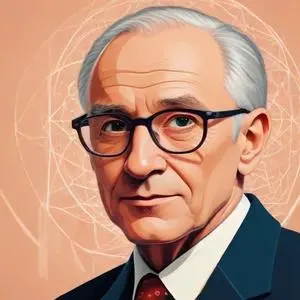
A pioneer in quantum mechanics, he developed the statistical interpretation of wave functions, revolutionizing our understanding of the atomic world. His work laid the foundation for modern physics and chemistry.
German-born physicist and mathematician Max Born is renowned for his instrumental role in the development of quantum mechanics, a fundamental concept that revolutionized our understanding of the physical world. His groundbreaking work, which earned him the 1954 Nobel Prize in Physics, has had a profound impact on the advancement of modern science.
Born on December 11, 1882, in Breslau, Germany (now Wroclaw, Poland), Max Born showcased exceptional academic prowess from an early age. He pursued higher education at the University of Göttingen, where he encountered esteemed mathematicians Felix Klein, David Hilbert, and Hermann Minkowski. Born's PhD thesis, "Stability of Elastica in a Plane and Space," won the University's Philosophy Faculty Prize in 1907.
Born's research focus shifted to special relativity in 1905, working alongside Minkowski. He later delved into the Thomson model of the atom, culminating in his habilitation thesis. In 1918, a chance meeting with Fritz Haber led to the discovery of the Born-Haber cycle, which explains the formation of ionic compounds.
During World War I, Born's expertise in sound ranging led to his involvement in research duties. In 1921, he returned to the University of Göttingen, where he established a chair for his friend and colleague James Franck. Under Born's guidance, Göttingen became a hub forPhysics. In 1925, he collaborated with Werner Heisenberg to formulate the matrix mechanics representation of quantum mechanics.
The following year, Born formulated the standard interpretation of the probability density function for ψ in the Schrödinger equation, earning him the Nobel Prize in 1954. His influence extended beyond his own research, shaping the work of notable physicists such as Max Delbrück, Siegfried Flügge, Friedrich Hund, Pascual Jordan, Maria Goeppert-Mayer, Lothar Wolfgang Nordheim, Robert Oppenheimer, and Victor Weisskopf.
Max Born's work has had a profound impact on modern science, shaping our understanding of quantum mechanics and inspiring future generations of physicists. His contributions have far-reaching implications for fields such as solid-state physics, optics, and materials science.
Born's legacy extends beyond the scientific community, with his work influencing popular culture and inspiring new areas of research. His commitment to education and his role as a mentor to numerous prominent physicists have cemented his place as one of the most influential scientists of the 20th century.
"I believe that the ideas of quantum mechanics will be seen as the most important contribution of the 20th century to the understanding of the universe."
"The world is not a collection of distinct objects, but a continuum, where everything is connected and interdependent."
Born was married to Hedwig Ehrenberg, with whom he had three children. He fled Nazi Germany in 1933, eventually settling in Edinburgh, Scotland, where he remained until his death on January 5, 1970.
Throughout his life, Born was driven by an insatiable curiosity and a passion for discovery. His work continues to inspire and challenge scientists, philosophers, and thinkers around the world.
Born in 1901
A pioneer in quantum mechanics, he formulated the uncertainty principle, which revolutionized our understanding of the atomic world. His groundbreaking work reshaped modern physics.
Born in 1885
A pioneer in quantum mechanics, he introduced the concept of wave-particle duality, revolutionizing our understanding of atomic structure. His philosophical approach to science also explored the nature of reality and human understanding.
Born in 1879
A brilliant physicist who developed the theory of relativity and is considered one of the most influential scientists of the 20th century, known for his groundbreaking work in physics and mathematics.
Born in 1902
A brilliant mind who formulated the Dirac equation, a fundamental concept in quantum mechanics, and predicted the existence of antimatter. His work revolutionized our understanding of the universe.
Born in 1892
A French physicist and Nobel laureate who proposed that particles, such as electrons, can exhibit wave-like behavior, revolutionizing quantum mechanics. His hypothesis led to major breakthroughs in understanding the atomic structure.
Born in 1894
This Indian physicist and mathematician is renowned for his groundbreaking work in quantum mechanics, particularly the discovery of the Bose-Einstein statistics and the boson particle.
Born in 1867
A pioneering scientist who pioneered radioactivity research, discovering elements polonium and radium, and paving the way for breakthroughs in medicine and energy.
