


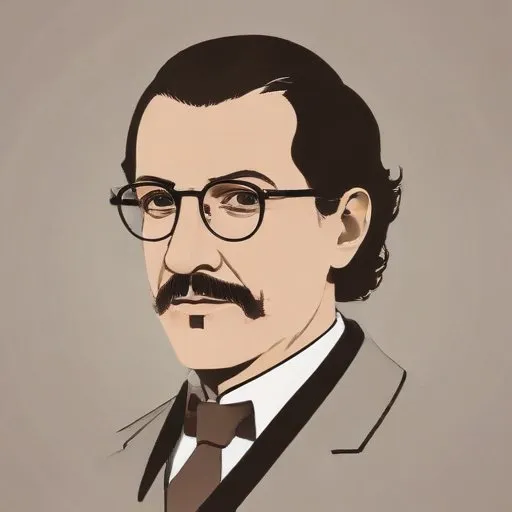
A pioneer in quantum mechanics, he developed the Hund's rules, which describe the filling of electron orbitals in atoms, and made significant contributions to our understanding of molecular structure.
Friedrich Hund is renowned for his groundbreaking work on the electronic configuration of chemical elements, famously known as Hund's rules. His pioneering research in molecular orbital theory has had a profound impact on our understanding of molecular structures, earning him a revered place in the annals of physics.
Friedrich Hermann Hund was born on February 4, 1896, in Karlsruhe, Germany. He pursued his academic interests in mathematics, physics, and geography at the University of Marburg and later at the University of Göttingen. This solid foundation in mathematics and physics laid the groundwork for his future achievements in the field.
Hund's illustrious scientific career was marked by collaborations with some of the most influential physicists of his time, including Erwin Schrödinger, Paul Dirac, Werner Heisenberg, Max Born, and Walther Bothe. As an assistant to Max Born, Hund worked on the quantum interpretation of band spectra of diatomic molecules. His association with Born had a significant impact on his work, and he later went on to make substantial contributions to the field of quantum theory.
Hund held various academic positions throughout his career, including private lecturer for theoretical physics at the University of Göttingen (1925), professor at the University of Rostock (1927), Leipzig University (1929), University of Jena (1946), and University of Frankfurt (1951). He finally returned to the University of Göttingen in 1957, where he continued to lecture and conduct research.
Hund's work on molecular orbital theory, particularly his development of Hund's rules and Hund's cases, has been instrumental in understanding the structure of molecules. His research on the electronic configuration of atoms and molecules paved the way for a deeper understanding of chemical bonding and molecular spectra.
One of Hund's most significant contributions was the discovery of the tunnel effect, also known as quantum tunneling, in 1926. This phenomenon has far-reaching implications in various fields, including chemistry, physics, and materials science.
Hund's work had a profound impact on the development of quantum chemistry, and his contributions are still widely acknowledged today. Robert S. Mulliken, the 1966 Nobel laureate in Chemistry, often credited Hund's work as a significant influence on his own research in molecular orbital theory. In recognition of Hund's contributions, the theory is often referred to as the Hund-Mulliken MO theory.
Hund published over 250 papers and essays throughout his career, cementing his position as a leading figure in the field of quantum physics. His work continues to inspire researchers and scientists, ensuring his legacy as a pioneer in the field of atomic and molecular physics.
Friedrich Hund lived a long and fulfilling life, passing away on March 31, 1997, at the age of 101. Throughout his life, he remained dedicated to his work, leaving behind a rich legacy that continues to shape our understanding of the atomic and molecular world.
Friedrich Hund's remarkable life and work serve as a testament to the power of human curiosity and ingenuity, inspiring future generations of scientists and researchers to continue exploring the mysteries of the atomic and molecular world.
Born in 1901
A pioneer in quantum mechanics, he formulated the uncertainty principle, which revolutionized our understanding of the atomic world. His groundbreaking work reshaped modern physics.
Born in 1885
A pioneer in quantum mechanics, he introduced the concept of wave-particle duality, revolutionizing our understanding of atomic structure. His philosophical approach to science also explored the nature of reality and human understanding.
Born in 1858
A pioneer in quantum theory, he introduced the concept of the Planck constant, revolutionizing our understanding of energy and matter.
Born in 1879
A brilliant physicist who developed the theory of relativity and is considered one of the most influential scientists of the 20th century, known for his groundbreaking work in physics and mathematics.
Born in 1879
A pioneering nuclear chemist who discovered nuclear fission, a process that releases massive energy from atomic nuclei, and was awarded the Nobel Prize in Chemistry in 1944.
Born in 1878
Pioneering physicist who made groundbreaking contributions to nuclear physics, including the discovery of nuclear fission, and was the first woman to become a full professor of physics in Germany.
Born in 1864
Developed groundbreaking geometric methods that transformed our understanding of space and time, and his work laid the foundation for Einstein's theory of relativity.
