


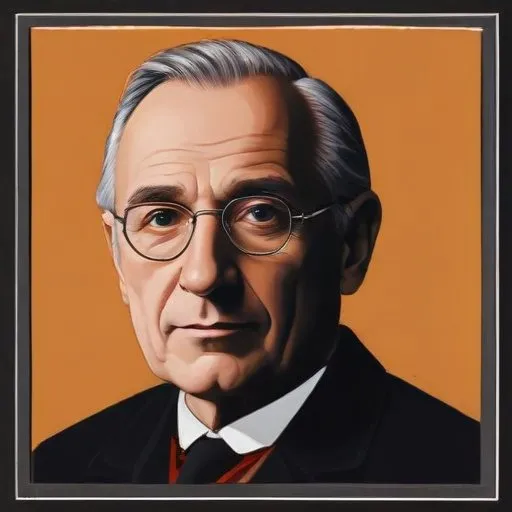
A German physicist and Nobel laureate who pioneered work on electron spin and the Franck-Condon principle, revolutionizing our understanding of molecular physics.
James Franck, a German physicist, is renowned for his pioneering work in the field of quantum physics, which earned him the Nobel Prize in Physics in 1925, alongside Gustav Hertz. Their collaborative research revealed the laws governing the impact of an electron upon an atom, paving the way for a deeper understanding of atomic structure.
Born on August 26, 1882, in Hamburg, Germany, Franck completed his doctorate in 1906 and his habilitation in 1911 at the Frederick William University in Berlin. His academic pursuits were interrupted by World War I, during which he served as a volunteer in the German Army and was seriously injured in a gas attack in 1917.
Franck was a strong advocate for the careers of women in physics, providing crucial support to prominent female physicists such as Lise Meitner, Hertha Sponer, and Hilde Levi. His efforts helped pave the way for future generations of women in the field.
In 1933, Franck resigned from his post in protest against the dismissal of fellow academics by the Nazi regime. He subsequently assisted Frederick Lindemann in helping dismissed Jewish scientists find work overseas before leaving Germany in November 1933. Franck spent a year at the Niels Bohr Institute in Denmark before moving to the United States, where he worked at Johns Hopkins University in Baltimore and later the University of Chicago.
During World War II, Franck participated in the Manhattan Project as Director of the Chemistry Division of the Metallurgical Laboratory. He also chaired the Committee on Political and Social Problems regarding the atomic bomb, which produced the Franck Report, a document that warned of the devastating consequences of atomic warfare.
James Franck's pioneering work in quantum physics, his commitment to promoting women in physics, and his courageous stance against Nazi oppression have left an indelible mark on the scientific community. His contributions continue to inspire new generations of physicists, ensuring his legacy as one of the most important scientists of the 20th century.
"Science is a cruel mistress. She beckons, but she does not reward."
Franck's life and work spanned a tumultuous period in world history, from the rise of Nazi Germany to the development of the atomic bomb. His struggles and triumphs serve as a testament to the power of science to shape our understanding of the world and our place within it.
Born in 1858
A pioneer in quantum theory, he introduced the concept of the Planck constant, revolutionizing our understanding of energy and matter.
Born in 1879
A brilliant physicist who developed the theory of relativity and is considered one of the most influential scientists of the 20th century, known for his groundbreaking work in physics and mathematics.
Born in 1885
A pioneer in quantum mechanics, he introduced the concept of wave-particle duality, revolutionizing our understanding of atomic structure. His philosophical approach to science also explored the nature of reality and human understanding.
Born in 1901
A pioneer in quantum mechanics, he formulated the uncertainty principle, which revolutionized our understanding of the atomic world. His groundbreaking work reshaped modern physics.
Born in 1879
A pioneering nuclear chemist who discovered nuclear fission, a process that releases massive energy from atomic nuclei, and was awarded the Nobel Prize in Chemistry in 1944.
Born in 1878
Pioneering physicist who made groundbreaking contributions to nuclear physics, including the discovery of nuclear fission, and was the first woman to become a full professor of physics in Germany.
Born in 1864
Developed groundbreaking geometric methods that transformed our understanding of space and time, and his work laid the foundation for Einstein's theory of relativity.
