


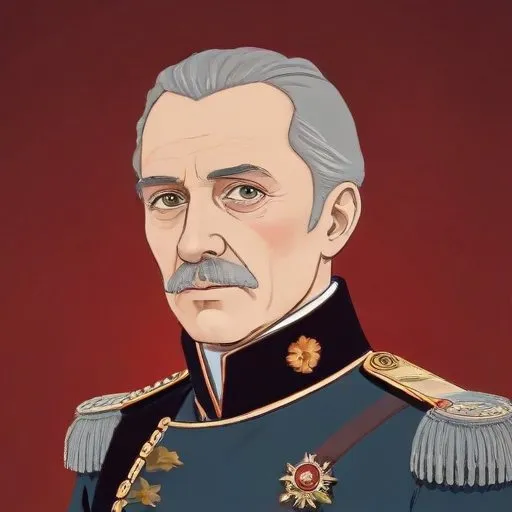
An Austrian general who fought against Napoleon and later became a prominent military strategist, known for his innovative tactics and leadership during the Napoleonic Wars.
Ludwig von Wallmoden-Gimborn is best known for his pioneering work in refining the Tirailleur system, a light infantry tactic that transformed the face of modern warfare. As a highly decorated Austrian General of the Cavalry, Wallmoden's innovative approach to military strategy earned him recognition and respect from his contemporaries.
Born on February 6, 1769, Wallmoden-Gimborn was the second son of Johann Ludwig Reichsgraf von Wallmoden-Gimborn and his first wife, Charlotte Christiane Auguste Wilhelmine von Wangenheim. His father, a British ambassador in Austria, was an illegitimate son of George II of Great Britain by his mistress Amalie von Wallmoden. This unique ancestry made Wallmoden-Gimborn a part of the broader British royal family.
Wallmoden-Gimborn's military career spanned across three armies: Hanoverian, Prussian, and Austrian. He entered the Hanoverian Army and later joined the Prussian Army in 1790, where he distinguished himself at the Battle of Kaiserslautern, earning the prestigious Pour le Mérite award.
In 1795, Wallmoden-Gimborn joined the Austrian army as a second captain in Vecsey's Hussars. He rapidly rose through the ranks, becoming a major in 1797 and a lieutenant colonel in 1798. He eventually became a colonel of the Ulanenregiment No. 1 and played a crucial role in completing the negotiations for the Subsidienvertrag between Austria and Great Britain in 1809.
Wallmoden-Gimborn's most significant contribution to military history was his refinement of the Tirailleur system. This light infantry tactic involved deploying small, agile units to harass and disrupt enemy formations, allowing for more effective and mobile warfare. His work in this area revolutionized modern warfare and earned him recognition as one of the most innovative military strategists of his time.
Despite his many achievements, Wallmoden-Gimborn is perhaps most notable for being the only individual from his generation within the broader British royal family to have been photographed. This unique distinction adds a touch of modernity to his otherwise traditional military legacy.
Wallmoden-Gimborn's life and legacy serve as a testament to the power of innovation and strategic thinking in shaping the course of modern warfare. His contributions to the Tirailleur system continue to influence military tactics to this day, cementing his place as one of the most important military minds of his time.
Born in 1769
A French military leader who rose to prominence during the French Revolution and became Emperor of France, known for his military conquests and reorganization of Europe. He is also famous for his Napoleonic Code, which remains a foundation of modern law.
Born in 1777
King of the Two Sicilies from 1825 to 1830, known for his attempts to reform the government and economy, but ultimately failing to modernize the kingdom.
Born in 1773
The 1st State Chancellor of the Austrian Empire, a master diplomat and strategist who maintained European peace and balance of power through clever alliances and negotiations, shaping the continent's politics for decades.
