


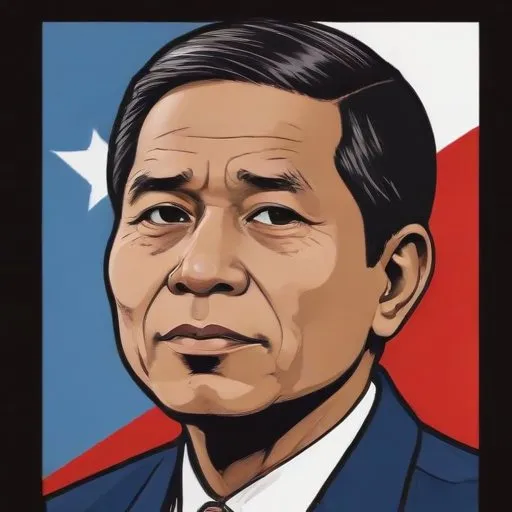
A Filipino communist leader who fought against Japanese occupation and later led the Hukbalahap rebellion against the Philippine government, advocating for land reform and social justice.
Luis Taruc, a prominent Filipino political figure, is renowned for leading the Hukbalahap movement, a peasant-based rebellion that fought against the Japanese occupation during World War II and later against the government's neglect of agrarian reform.
As the commander-in-chief of the Hukbalahap, Taruc's bravery and strategic thinking led the group to become one of the most formidable forces in the country, with an estimated fighting strength of 10,000 to 30,000 members at its peak.
Born on June 21, 1913, in the barrio of Santa Monica, township of San Fernando, Pampanga, Taruc grew up in a peasant family, witnessing firsthand the struggles of the Filipino farmers and workers.
His exposure to the plight of the agrarian Filipinos during his student days in the early 1930s sparked his desire to take action, leading him to join the Aguman ding Maldang Talapagobra (AMT), or the Union of Peasant Workers, in 1938.
Influenced by his socialist idol, Pedro Abad Santos, and inspired by the earlier Katipunan revolutionaries, Taruc's involvement with the movement deepened, and he eventually joined the Partido Sosyalista ng Pilipinas (Socialist Party of the Philippines) in 1938.
The party later merged with the Partido Komunista ng Pilipinas (Communist Party of the Philippines) as part of the Common Front strategy, and Taruc assumed the role of Commander-in-Chief of the military wing created to fight the Japanese occupation.
During World War II, Taruc led the Hukbalahap in a series of guerrilla operations against the Japanese occupiers, employing tactics such as sabotage, ambushes, and raids to disrupt the enemy's supply lines and communication networks.
Though the war took a heavy toll on the Filipino people, Taruc's leadership and the Hukbalahap's bravery paved the way for the eventual defeat of the Japanese forces and the country's liberation.
After the war, the Hukbalahap continued to fight for agrarian reform, demanding land redistribution and better working conditions for the farmers and workers.
Taruc and seven of his colleagues were elected to the House of Representatives, but the government of Manuel Roxas refused to allow them to take their seats, fearing the Hukbalahap's growing popularity and influence.
In 2017, the National Historical Commission of the Philippines declared Taruc a hero for his unwavering commitment to the rights of farmers and workers, solidifying his place in the country's history as a champion of social justice and equality.
Today, Taruc's legacy serves as a beacon of hope for those fighting for the rights of the marginalized and oppressed, inspiring generations to come.
Through his fearless leadership and unwavering commitment to social justice, Luis Taruc left an indelible mark on Philippine history, inspiring future generations to fight for the rights of the marginalized and oppressed.
Born in 1917
A Filipino leader who ruled with an iron fist, implementing martial law and amassing wealth, leaving a legacy of controversy and economic turmoil.
93 Years Old
First female president of the Philippines, led the People Power Revolution, and restored democracy after decades of authoritarian rule.
93 Years Old
A Filipino journalist and politician who led the opposition against Ferdinand Marcos' regime, known for his courageous fight for democracy and human rights. Assassinated in 1983, his death sparked the People Power Revolution.
