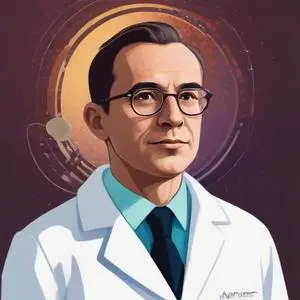
Luis Walter Alvarez

Luis Walter Alvarez

Luis Walter Alvarez was born on June 13th, 1911

Full Name: Luis Walter Alvarez
Place of Birth: San Francisco, California, USA
Profession: Physicist, Academic
Awards: Nobel Prize in Physics
University: University of California, Berkeley
Field: Particle physics
Discovery: Antiproton
Born: June 13, 1911

A pioneering physicist who uncovered the secrets of subatomic particles and developed groundbreaking detection methods, earning a Nobel Prize in Physics.

Written by: Fatima Ahmed Fatima Ahmed

A Life of Innovation and Breakthroughs

Luis Walter Alvarez, a renowned American experimental physicist, is best known for his Nobel Prize-winning discovery of resonance states in particle physics using the hydrogen bubble chamber. This groundbreaking achievement has had a lasting impact on the field of physics, cementing Alvarez's status as one of the most brilliant and productive experimental physicists of the 20th century.

Early Life and Education

Born on June 13, 1911, in San Francisco, California, Alvarez grew up in a family of modest means. His father, Walter Alvarez, was a physician, and his mother, Harriet SMith, was an educator. Alvarez's innate curiosity and passion for science were evident from an early age. He pursued his undergraduate studies at the University of Chicago, where he earned his degree in physics in 1932. He went on to earn his Ph.D. in physics from the University of Chicago in 1936.

A Career of Innovation and Collaboration

Alvarez's academic and professional pursuits took him to the University of California, Berkeley, where he worked with Ernest Lawrence at the Radiation Laboratory. During this period, he devised a set of experiments to observe Kelectron capture in radioactive nuclei, predicted by the beta decay theory but never before observed. He also produced tritium using the cyclotron and measured its lifetime. Collaborating with Felix Bloch, Alvarez measured the magnetic moment of the neutron.

World War II Contributions

In 1940, Alvarez joined the MIT Radiation Laboratory, where he contributed significantly to various World War II radar projects. His work included early improvements to Identification friend or foe (IFF) radar beacons, now called transponders, and a system known as VIXEN for preventing enemy submarines from realizing that they had been found by the new airborne microwave radars. Alvarez is perhaps most notable for his development of Ground Controlled Approach (GCA), a radar system that played a crucial role in aviation, particularly in the post-war Berlin airlift.

The Manhattan Project and Beyond

Alvarez spent a few months at the University of Chicago working on nuclear reactors for Enrico Fermi before joining the Manhattan Project at Los Alamos. Under the guidance of Robert Oppenheimer, Alvarez worked on the design of explosive lenses and the development of exploding-bridgewire detonators. As a member of Project Alberta, he observed the Trinity nuclear test from a B-29 Superfortress and later witnessed the bombing of Hiroshima from the B-29 "The Great Artiste."

Awards and Honors

Alvarez's numerous contributions to physics and his groundbreaking discoveries earned him numerous awards and honors, including:
  • Nobel Prize in Physics (1968)
  • National Medal of Science (1963)
  • Enrico Fermi Award (1987)

Personal Life and Legacy

Alvarez's personal life was marked by simplicity and humility. He was known for his kind and gentle nature, despite his immense intellectual prowess. Throughout his life, Alvarez remained committed to his family and was deeply devoted to his wife, Geraldine Smithwick, whom he married in 1936. Alvarez's legacy extends far beyond his groundbreaking discoveries. He inspired generations of physicists and scientists, leaving behind a rich tapestry of innovative ideas and groundbreaking research that continue to shape the field of physics today.

Quotes and Memorable Sayings

"I have always believed that the way to get good ideas is to get a lot of ideas." – Luis Walter Alvarez This quote encapsulates Alvarez's approach to science and life, emphasizing the importance of curiosity, creativity, and perseverance in the pursuit of knowledge.

Remembering Luis Walter Alvarez

Luis Walter Alvarez passed away on September 1, 1988, leaving behind a legacy that continues to inspire and influence the scientific community. His remarkable life, marked by innovation, collaboration, and groundbreaking discoveries, serves as a testament to the power of human curiosity and the importance of pursuing knowledge for the greater good.
Timeline
1911
Birth in San Francisco, California
Luis Walter Alvarez was born on June 13, 1911, in San Francisco, California, USA. He would go on to become a physicist and Nobel laureate.
1936
Earned Ph.D. in Physics
Alvarez earned his Ph.D. in physics from the University of Chicago, where he studied under the Nobel laureate Arthur Compton.
1944
Developed the Radar System
Alvarez developed a radar system for microwave radiation, which was used in World War II and later led to the development of radar astronomy.
1960
Discovered the Omega-Minus Particle
Alvarez discovered the omega-minus particle, a subatomic particle that is a key component of the standard model of particle physics.
1987
Passing Away
Luis Walter Alvarez passed away on September 1, 1987, at the age of 76, leaving behind a legacy as one of the most important physicists of the 20th century.
Luis Walter Alvarez

Luis Walter Alvarez Quiz

Luis Walter Alvarez's Nobel Prize in Physics was awarded for his discovery of

Score: 0/5
FAQ
What is Luis Walter Alvarez known for in physics?
Luis Walter Alvarez is known for his work on particle physics, including the discovery of several subatomic particles and the development of the bubble chamber.
What is Luis Walter Alvarezs most notable discovery?
Luis Walter Alvarezs most notable discovery is that of the antiproton, for which he was awarded the Nobel Prize in Physics in 1968.
What is Luis Walter Alvarezs contribution to the field of radiation detection?
Luis Walter Alvarezs contribution to the field of radiation detection is that of a pioneer in the development of radiation detectors, including the first practical muon detector.
Where did Luis Walter Alvarez work during his career?
Luis Walter Alvarez worked at several institutions during his career, including the University of California, Berkeley, and the Lawrence Radiation Laboratory.
What is Luis Walter Alvarezs legacy in physics?
Luis Walter Alvarezs legacy in physics is that of a pioneering experimental physicist who made significant contributions to our understanding of subatomic particles and radiation detection.

Related People:

Enrico Fermi

Born in 1901

A pioneer in nuclear physics, known for leading the team that developed the first nuclear reactor and playing a crucial role in the development of the atomic bomb.

Richard Feynman

Born in 1918

A brilliant physicist and engineer who pioneered quantum mechanics and famously explained complex concepts in simple terms, making science accessible to all.

Murray Gell-Mann

97 Years Old

A pioneer in particle physics, discovering subatomic particles like quarks and gluons, and developing the theory of quantum chromodynamics.

Stephen Hawking

84 Years Old

A brilliant mind who unraveled the mysteries of black holes and the universe, making complex physics accessible to all through bestselling books.

Leon M. Lederman

Born in 1922

A Nobel Prize-winning physicist and mathematician who discovered the muon neutrino, a subatomic particle, and made significant contributions to our understanding of the universe. His work has far-reaching implications for particle physics and beyond.

Sheldon Glashow

93 Years Old

Developed a unified theory of electromagnetism and the weak nuclear force, predicting the existence of neutral currents. This work led to a deeper understanding of subatomic particles and their interactions.

Julian Schwinger

Born in 1918

A pioneering physicist who developed the theory of quantum electrodynamics, earning a Nobel Prize in Physics in 1965 for his groundbreaking work.

Freeman Dyson

Born in 1923

A renowned physicist and mathematician who made groundbreaking contributions to quantum electrodynamics and futurism, proposing innovative ideas like the Dyson sphere.