


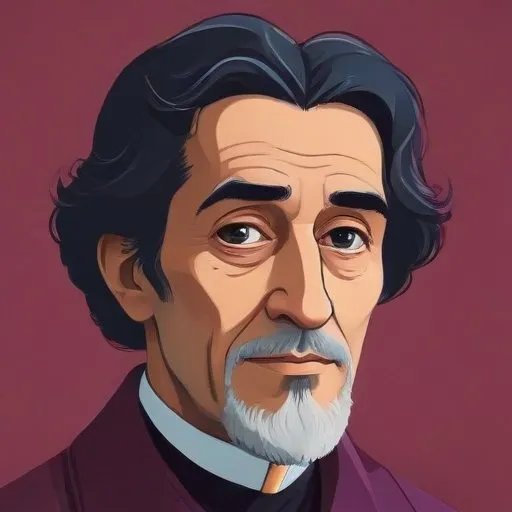
A 18th-century Portuguese philosopher and pedagogue who advocated for educational reform and emphasized the importance of reason, critical thinking, and individual freedom. He's known for his influential writings on education and Enlightenment values.
Lus Antnio Verney is renowned for his groundbreaking contributions to the Portuguese Enlightenment, particularly in the realm of education. As a philosopher, theologian, and pedagogue, Verney advocated for a radical overhaul of the educational system in Portugal, which was then dominated by the Jesuits.
Verney was born in Lisbon on July 23, 1713, to a family of wealthy merchants. His parents, Denys Verney and Maria da Conceio Arnaut, were of French and Portuguese descent, respectively. Verney was one of 10 siblings and received his early education from the family's chaplain, Fr. Manuel de Aguiar Paixo.
He later studied at the Jesuit College of Saint Antony the Abbot and the Convent of the Holy Spirit of the Quarry, where he developed a strong foundation in Latin Grammar, Spanish, French, and Italian. Verney's academic pursuits took him to the University of vora, where he earned a degree in Philosophy and Theology.
Verney's most notable achievement is his controversial manifesto, Verdadeiro Mtodo de Estudar, first published anonymously in 1746. This treatise proposed a comprehensive reform of the educational system, which was met with fierce opposition from the Jesuits. Verney's work emphasized the importance of critical thinking, scientific inquiry, and secular education, marking a radical departure from the traditional methods employed by the Jesuits.
Verney's manifesto served as a catalyst for the educational reforms instituted under the Marquis of Pombal, who shared Verney's vision for a more modern and secular education system. The Verdadeiro Mtodo de Estudar remains a seminal work in the history of Portuguese education, continuing to influence educational policies to this day.
Verney's contributions to the Portuguese Enlightenment had far-reaching implications for modern society. His advocacy for a more inclusive and secular education system helped pave the way for the development of a more liberal and democratic society in Portugal.
Verney's emphasis on critical thinking and scientific inquiry also contributed to the growth of intellectual curiosity and the advancement of scientific knowledge in Portugal. His legacy continues to inspire educational reformers and policymakers who seek to create a more equitable and progressive education system.
Lus Antnio Verney's pioneering work in education and philosophy has left an indelible mark on Portuguese history. His commitment to creating a more inclusive and secular education system continues to inspire generations of educators, policymakers, and scholars.
As a testament to his enduring legacy, Verney's ideas remain relevant in contemporary discussions on education reform, serving as a powerful reminder of the importance of critical thinking, scientific inquiry, and the pursuit of knowledge.
Born in 1596
Developed influential philosophical and mathematical concepts, including the famous phrase "I think, therefore I am," and laid the foundation for modern Western philosophy.
Born in 1632
A 17th-century thinker who laid the groundwork for modern democracy, arguing that governments derive their power from the people and that individuals have inherent rights to life, liberty, and property.
Born in 1724
Developed influential philosophical frameworks, such as the Critique of Pure Reason, that shaped modern Western thought on ethics, morality, and human understanding.
Born in 1712
A pioneering thinker who shaped modern democracy and education with his ideas on social contracts, general will, and the importance of early childhood education. His writings influenced the French Revolution and modern political thought.
Born in 1694
A witty and insightful 18th-century writer and philosopher who used satire to critique societal norms and advocate for reason, tolerance, and human rights.
Born in 1632
A 17th-century philosopher and scholar who developed a comprehensive philosophical system that emphasizes God, nature, and human freedom, influencing modern thought on ethics, politics, and religion.
Born in 1646
Developed calculus independently of Isaac Newton, and made major contributions to the fields of philosophy, politics, and history.
Born in 1561
A 16th-17th century Renaissance figure who pioneered the scientific method and empiricism, and served as a prominent government official.
