


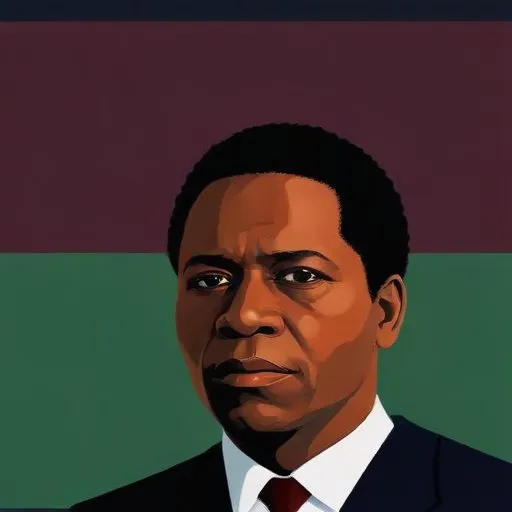
The first Prime Minister of Zambia, leading the country to independence from British colonial rule and shaping its early years, known for his role in the nation's formative period.
Mainza Chona, a stalwart figure in Zambian politics, is renowned for his instrumental role in shaping the country's history as the founder of the United National Independence Party (UNIP) and serving as the third Vice President of Zambia from 1970 to 1973. His profound political acumen and leadership prowess led him to occupy the Prime Minister's office on two occasions, from 1973 to 1975 and again from 1977 to 1978.
Born Sikaye Chingula Namukamba on January 21, 1930, in Nampeyo, near Monze, in the Batoka Province of the British colony of Northern Rhodesia (now Southern Province, Zambia), Chona's early life was marked by a strong sense of ambition and a thirst for knowledge. His father, Hameja Chilala, also known as Chief Chona, played a significant role in his education, requesting the establishment of a school at Nampeyo, where Chona received his primary education.
Chona's academic pursuits took him to Chikuni, the Jesuit headquarters, where he converted to Catholicism. He completed his secondary education at Munali Secondary School in Lusaka in 1951. Chona's burning desire to become a lawyer led him to secure a scholarship, which took him to London in 1955. He studied at Grays Inn and was called to the bar in 1958.
During his time in England, Chona forged relationships with other African nationalists, including Harry Nkumbula and Kenneth Kaunda. He also made contact with London-based White supporters of African independence. Upon his return to Zambia, Chona's involvement in politics intensified, and he became an integral part of the country's struggle for independence.
In 1964, Chona served as Justice Minister, a position he held until 1968. He then took up the role of Home Affairs Minister, which he held until 1969. His dedication to public service earned him the position of Minister of Legal Affairs and Attorney-General, which he held from 1975 to 1978.
Chona's leadership acumen and vision for Zambia led him to become the Secretary-General of UNIP, the ruling party, from 1978 to 1981. This position made him the de facto second in command in the hierarchy of Zambian politics during the period of the One-Party Participatory State (1973-1991). He later served as Ambassador to the People's Republic of China from 1984 to 1989 and then as Ambassador to France.
Mainza Chona's legacy extends beyond his politics. He was a champion of education, and his contributions to the development of Zambia's education system are still felt today.
Mainza Chona's life was a testament to his unwavering commitment to Zambia's development and his unrelenting pursuit of excellence. His contributions to the country's politics, education, and society continue to inspire generations, cementing his place as one of Zambia's most revered leaders.
Born in 1924
First president of Zambia, leading the country to independence from British colonial rule and advocating for African unity and development.
78 Years Old
A Zambian lawyer and politician who served as the 3rd President of Zambia, known for his efforts to combat corruption and promote economic development in his country. He was a key figure in shaping Zambia's modern political landscape.
83 Years Old
The second President of Zambia, who served from 1991 to 2002, is known for introducing multiparty democracy and overseeing the country's transition from a one-party state. He's also infamous for corruption and embezzlement allegations.
89 Years Old
A Zambian police officer-turned-politician who served as the 5th President of Zambia, known for his populist policies and anti-Chinese rhetoric. He's remembered for his efforts to increase the country's economic independence.
Born in 1924
The 2nd President of Zimbabwe, a controversial figure who ruled with an iron fist, known for his country's economic downfall and human rights abuses.
Born in 1922
First President of Tanzania, led the country to independence from British colonial rule and implemented socialist policies, known for his Pan-Africanism and anti-colonialism efforts.
