


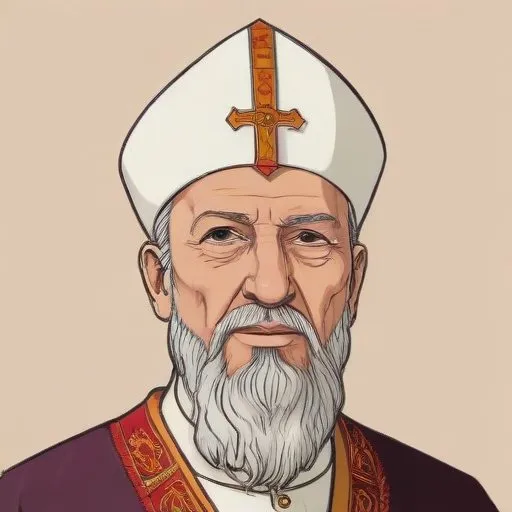
The first President of Cyprus, a key figure in the country's independence from British rule, and a champion of Cypriot unity and sovereignty. He played a crucial role in shaping the island nation's early years.
Makarios was born in Panayia village in the Paphos District on 13 August 1913. He was admitted to Kykkos Monastery as a novice at the age of 13 and later completed his secondary education at the Pancyprian Gymnasium in Nicosia. He pursued theology and law at the University of Athens during World War II, graduating in 1942.
He was sent to Boston University in Massachusetts on a World Council of Churches scholarship, where he studied further. In 1948, while still studying, he was unexpectedly elected Bishop of Kition, a role he accepted reluctantly. He adopted the clerical name Makarios, meaning "happy, fortunate, blessed," during this time.
In the 1940s and 1950s, Makarios was an active supporter of enosis, the union of Cyprus with Greece. He was elected Archbishop of Cyprus in 1950, a position that not only made him the head of the Orthodox Church in Cyprus but also the de facto national leader of Cypriots.
As Archbishop, Makarios played a crucial role in the EOKA (Ethniki Organosis Kyprion Agoniston) movement, which fought for Cyprus' independence from British colonial rule. His leadership and vision helped bring international attention to the cause, eventually leading to the signing of the Zurich and London Agreements in 1959, which granted Cyprus independence.
Makarios became the first President of Cyprus in 1960, a position he held until 1977. During his presidency, he worked tirelessly to establish the newly independent nation, promoting unity and cooperation among Cypriots. He also played a key role in shaping the country's international relations, becoming a respected figure on the global stage.
Despite facing numerous challenges, including a coup attempt in 1974, Makarios remained committed to his vision for a united and prosperous Cyprus. His legacy continues to inspire Cypriots today, with his name synonymous with courage, wisdom, and leadership.
Makarios was a firm believer in the importance of education, democracy, and social justice. He advocated for the rights of the poor and marginalized, and his commitment to the Greek Cypriot community helped shape the country's cultural and national identity.
His philosophical approach to leadership emphasized the need for cooperation, compromise, and dialogue. He famously said, "The path to freedom is not a straight one, but a winding one, full of obstacles and difficulties."
Makarios' legacy extends beyond Cyprus, with his commitment to democracy, human rights, and social justice inspiring leaders and citizens worldwide. His vision for a united and prosperous Cyprus continues to shape the country's politics, economy, and society.
His influence can be seen in the many institutions, buildings, and monuments named after him, including the Makarios III Avenue in Nicosia and the Archbishop Makarios III Museum in Panayia.
Makarios' life and leadership coincided with a pivotal period in Cyprus' history, marked by colonial rule, nationalist movements, and the struggle for independence. His vision, courage, and diplomacy helped shape the country's transition from colonial rule to independence.
Today, Makarios III is remembered as a national hero, a symbol of Cypriot identity, and a champion of democracy and human rights. His legacy continues to inspire future generations, serving as a beacon of hope and freedom for people around the world.
Born in 1913
The first President of Cyprus, a key figure in the country's independence from British rule, and a champion of Cypriot unity and sovereignty. He played a crucial role in shaping the island nation's early years.
Born in 1919
A Cypriot lawyer and politician who served as the 4th President of Cyprus, known for his efforts to reunify the island nation and resolve the Cyprus dispute. He played a key role in shaping the country's modern politics and economy.
92 Years Old
The 5th President of Cyprus, a key figure in the country's politics, known for his efforts to reunify the island nation and resolve the Cyprus dispute. He played a crucial role in shaping Cyprus' foreign policy and EU relations.
Born in 1924
First President of Northern Cyprus, leading the country to independence and self-governance after a long struggle. He played a crucial role in shaping the nation's politics and identity.
Born in 1898
A Greek Cypriot general and nationalist who led the EOKA resistance movement against British colonial rule in Cyprus, and later founded the EOKA-B paramilitary organization. He's known for his guerrilla warfare tactics and fight for Cypriot independence.
