


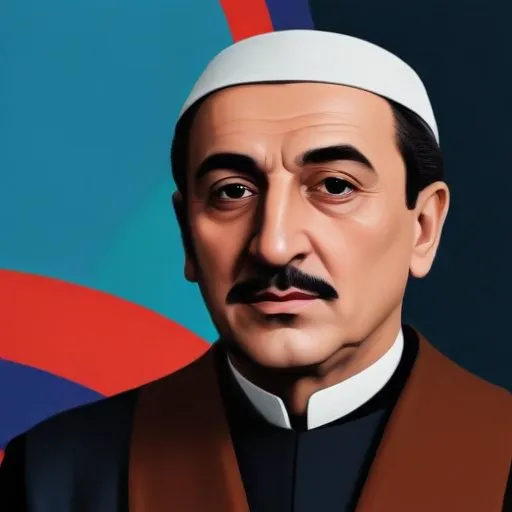
Azerbaijan's first president, a key figure in the country's struggle for independence, and a prominent scholar who played a crucial role in shaping the nation's identity and politics.
Mammad Amin Rasulzade, a pioneering Azerbaijani politician, writer, and philosopher, is revered for his instrumental role in shaping the country's struggle for independence and national identity. As the leader of the Azerbaijani Democratic Republic, Rasulzade played a crucial part in declaring Azerbaijan's independence from Russia in 1918, earning him the title of "Father of Azerbaijani Nationalism."
Born on January 31, 1884, in Novxanı, Baku Governorate, Russian Empire (now Azerbaijan), Rasulzade was raised in a family of modest means. His early education took place in local madrasas, where he developed a strong foundation in Islamic studies and literature. Later, he pursued higher education at the Transcaucasus Teachers' Seminary in Gori, Georgia, and eventually graduated from the University of Odessa in Ukraine.
Rasulzade's literary career began in the early 1900s, during which he wrote passionately about Azerbaijani nationalism and the need for independence from Russian rule. His writings, particularly in the newspaper Akinchi, helped fuel the growing nationalist sentiment among Azerbaijani intellectuals. In 1917, he co-founded the Musavat Party, which became the primary force behind the Azerbaijani independence movement.
Rasulzade's nationalist ideology emphasized the importance of Azerbaijani language, culture, and identity. He believed that a strong, independent Azerbaijan was essential for the country's economic and social development.
Rasulzade's philosophical contributions centered around the concept of "Turkism," which emphasized the unity and shared heritage of Turkic peoples. He believed that the promotion of Turkic culture and values was essential for the development of a strong, independent Azerbaijani state.
His writings also reflected a strong sense of humanism, advocating for democracy, equality, and social justice. Rasulzade's philosophical beliefs were deeply rooted in his Islamic heritage, but he also drew inspiration from Western liberal thinkers, such as Jean-Jacques Rousseau and John Locke.
Rasulzade's legacy is profound and far-reaching. He is remembered as a hero and a symbol of Azerbaijani national pride. His contributions to the country's independence and national identity have been immortalized in Azerbaijani literature, art, and culture.
Today, Rasulzade's ideas continue to inspire Azerbaijani intellectuals, politicians, and ordinary citizens. His legacy serves as a reminder of the importance of national identity, democracy, and human rights.
Rasulzade's personal life was marked by turmoil and exile. In 1920, he fled Azerbaijan to escape the Red Army's invasion, eventually settling in Turkey, where he continued to advocate for Azerbaijani independence.
Rasulzade's quotes and sayings continue to inspire and motivate Azerbaijani people to this day. One of his most famous quotes is:
"One nation, one state, one flag!"
This rallying cry has become an anthem for Azerbaijani nationalism and a testament to Rasulzade's unwavering commitment to his country's independence and unity.
Born in 1923
Azerbaijan's leader who ruled with an iron fist, modernizing the country while suppressing opposition, leaving a lasting legacy in the region.
64 Years Old
The 4th President of Azerbaijan, a leader who has dominated the country's politics since 2003, known for his authoritarian rule and efforts to maintain stability in the region.
Born in 1884
Azerbaijan's first president, a key figure in the country's struggle for independence, and a prominent scholar who played a crucial role in shaping the nation's identity and politics.
