


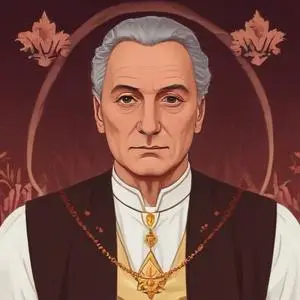
A renowned mystic and philosopher who wrote extensively on the occult, spirituality, and personal growth, leaving a lasting impact on modern esoteric thought.
Manly Palmer Hall, a philosopher, mystic, and writer, is renowned for his profound contributions to the realm of esoteric knowledge, spiritualism, and the mysteries of the human experience. As a 33° Mason, Hall's works delved into the depths of mysticism, alchemy, astrology, and the occult, earning him the title of "the Sage of Los Angeles."
Born on March 18, 1901, in Peterborough, Ontario, Canada, Hall's life was marked by an insatiable curiosity and a quest for spiritual truth. He moved to the United States in 1919, where he became fascinated with the teachings of Theosophy and the works of Helena Petrovna Blavatsky and William Quan Judge. This fascination led him to establish the Philosophical Research Society (PRS) in 1934, an organization dedicated to the study and dissemination of esoteric knowledge.
Hall's works have had a profound impact on modern spirituality, influencing philosophers, writers, and artists. His teachings have been cited by notable figures such as Aldous Huxley, Ray Bradbury, and Stanley Kubrick, and have inspired a new generation of seekers and thinkers.
Hall's teachings have not been without controversy. Critics have accused him of promoting a form of "elite spirituality," where esoteric knowledge is reserved for an initiated few. However, Hall's defenders argue that his teachings are intended to inspire individuals to seek their own path to spiritual truth, rather than relying on dogma or authority.
Hall's life and teachings are set against the backdrop of a tumultuous 20th century, marked by wars, social upheaval, and spiritual searching. As a pioneer of modern esotericism, Hall's legacy continues to inspire and provoke, challenging individuals to explore the mysteries of the human experience and the universe.
Hall's teachings can be compared to those of other notable esotericists, such as Aleister Crowley and Dion Fortune, who also explored the mysteries of the occult and the nature of the human soul. While Hall's teachings share some similarities with these contemporaries, his emphasis on the importance of spiritual seeking and the individual's role in their own illumination sets him apart.
Hall's relationships with his students and colleagues are marked by a sense of reverence and admiration. One notable student, Jean Overton Fuller, recalled Hall's wisdom and kindness, stating, "Manly Hall was a spiritual giant, whose compassion and understanding knew no bounds."
Hall's career spanned over six decades, during which he wrote over 150 books and lectures on a wide range of esoteric topics. His most notable works include The Secret Teachings of All Ages, Lectures on Ancient Philosophy, and The Initiates of the Flame.
Hall's teachings often veered into the realm of prophecy and speculation, where he would explore the possibilities of human evolution and the future of humanity. While some of these predictions have been misunderstood or misinterpreted, they remain a testament to Hall's boundless imagination and his willingness to challenge conventional thinking.
Hall's Philosophical Research Society (PRS) continues to provide a platform for esoteric education and research, attracting scholars and seekers from around the world. The PRS has also supported various charitable initiatives, including the establishment of a children's hospital in India.
Hall's life and teachings serve as a testament to the power of human curiosity and the importance of seeking spiritual truth. As a sage and a philosopher, Hall's legacy continues to inspire individuals to embark on their own journey of self-discovery and illumination.
Born in 1875
A renowned occultist and mystic who wrote extensively on magic, mysticism, and thelema, and is often associated with the phrase "Do what thou wilt shall be the whole of the Law."
Born in 1890
Creator of cosmic horror, crafting eerie tales of ancient deities and supernatural entities that lurk in the shadows, exploring the darker aspects of human nature. 82
Born in 1875
Developed the concept of collective unconscious and archetypes, and founded analytical psychology, which emphasizes the integration of opposites and the process of individuation.
Born in 1856
Pioneering psychoanalyst who developed theories on the subconscious mind, childhood experiences, and the structure of personality, revolutionizing our understanding of human behavior and psychology.
Born in 1831
Founded the Theosophical Society, promoting spiritual growth and universal brotherhood through esoteric wisdom and Eastern philosophy. Known for her influential writings on mysticism and the occult.
