


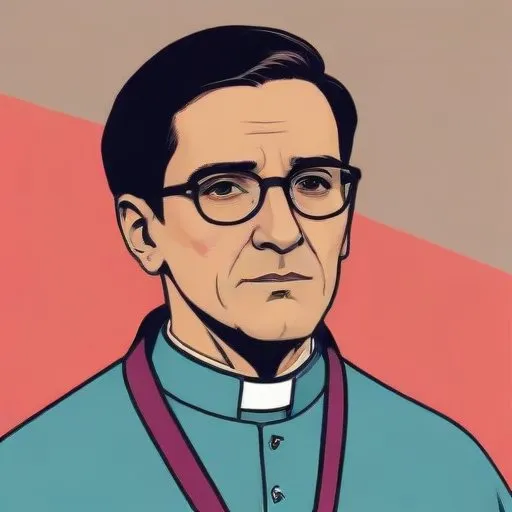
Argentinian priest and journalist who advocated for social justice and human rights through his writings and activism, inspiring positive change in his community.
Manuel Alberti, a Argentine priest from Buenos Aires, is remembered for his pivotal role in the country's May Revolution of 1810, serving as one of the seven members of the Primera Junta, the first national government of Argentina.
As a priest, Alberti's strong leadership skills and influential voice made him a key figure in the revolution, working closely with Mariano Moreno to shape the new government's policies.
Born on May 28, 1763, in Buenos Aires, Alberti was baptized at the Concepción parish, with Juan Javier Dógan and Isabel de Soria y Santa Cruz as his godparents.
After receiving the presbyterate in 1786, Alberti was appointed to the Concepción parish, where he quickly established himself as a charismatic leader and respected voice in the community.
During the British invasions of the River Plate, Alberti served as a curate at Maldonado, Uruguay, before returning to Buenos Aires in time to participate in the May Revolution of 1810.
As a member of the Primera Junta, Alberti supported many of Moreno's proposals, contributing to the development of the new government's policies.
He also worked as a writer for the Gazeta de Buenos Ayres newspaper, using his platform to promote the revolution's ideals and shape public opinion.
Alberti's health was negatively affected by internal disputes among the Junta members, eventually leading to his death from a heart attack on January 31, 1811.
Despite his untimely passing, Alberti's legacy as a pioneering figure in Argentina's struggle for independence has endured, earning him a permanent place in the country's history.
Although few quotes from Alberti have been recorded, his actions and dedication to the May Revolution speak louder than words, inspiring generations of Argentinians to fight for their freedom and independence.
89 Years Old
The leader of the Catholic Church, known for his progressive stance on social issues and efforts to reform the Church, inspiring millions worldwide.
99 Years Old
The first democratically elected president of Argentina after a period of military rule, known for his efforts to promote human rights and democracy in the country.
Born in 1895
The authoritarian leader who ruled Argentina with his charismatic wife Eva, implementing populist economic policies and promoting nationalism, while suppressing opposition and civil liberties.
Born in 1919
A former actress who used her charisma and influence to advocate for women's suffrage and workers' rights, becoming a beloved and powerful figure in Argentine politics.
94 Years Old
A passionate artist and human rights activist who used his art to promote social justice and non-violent resistance, and was awarded the Nobel Peace Prize in 1980.
