


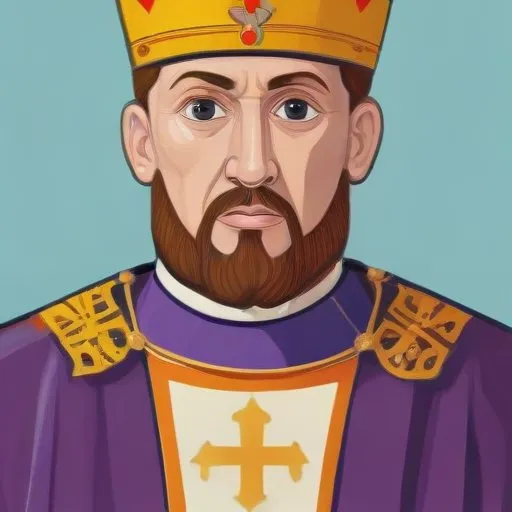
The last Byzantine emperor to rule from Constantinople, he's known for his efforts to unite the Eastern and Western churches and his writings on theology and politics.
Manuel II Palaiologos, also known as Palaeologus, is renowned for being the Byzantine Emperor who ruled from 1391 to 1425, navigating treacherous relationships with the Ottoman Empire and European courts to secure the throne. During his reign, he fought to preserve the dwindling Byzantine Empire, leaving a lasting legacy in the annals of history.
Born on June 27, 1350, Manuel was the second son of Emperor John V Palaiologos and his wife Helena Kantakouzene. He was granted the title of despot by his father and went on to seek support for the Byzantine Empire in the west. Manuel served as governor in Thessalonica from 1369 and was proclaimed heir and co-emperor of his father in 1373 after a failed attempt at usurpation by his older brother Andronikos IV Palaiologos.
Manuel's path to the throne was marked by turmoil and power struggles. In 1376-1379 and again in 1390, he and his father were supplanted by Andronikos IV and then his son John VII. However, Manuel personally defeated his nephew with the help of the Republic of Venice in 1390. Despite being forced to go as an honorary hostage to the court of the Ottoman Sultan Bayezid I, Manuel managed to escape and secure the capital against any potential claim by his nephew John VII after his father's death in 1391.
Manuel's reign was marked by a series of diplomatic efforts to secure alliances with European courts. He wrote letters to courts across Europe, pleading for support against the Ottoman Empire. In 1396, Manuel traveled to Europe, visiting Italy, France, and England, where he was received with great pomp and circumstance. Although he failed to secure significant military aid, his diplomatic efforts helped to foster a sense of European unity against the Ottoman threat.
Manuel II Palaiologos is commemorated by the Greek Orthodox Church on July 21. Shortly before his death, he was tonsured a monk and received the name Matthew. His wife Helena Draga ensured that their sons, John VIII and Constantine XI, became emperors, securing the Palaiologos dynasty's hold on the throne.
Manuel II Palaiologos' remarkable life is a testament to his unyielding spirit and determination to preserve the Byzantine Empire in the face of overwhelming odds. His legacy continues to inspire and fascinate historians to this day.
Born in 1405
The last ruler of the Byzantine Empire, who fought to defend Constantinople against the Ottoman Empire's siege, ultimately leading to the empire's downfall. He's remembered for his bravery and loyalty to his people.
Born in 1259
The Byzantine emperor who ruled from 1282 to 1328, known for his attempts to reform the empire's government and economy, and his conflicts with the Ottoman Turks.
Born in 1332
The last ruler of the Byzantine Empire, who reigned from 1341 to 1376 and is known for his attempts to reform the empire and defend it against the Ottoman Turks. He was a skilled diplomat and strategist, but ultimately failed to save the empire from collapse.
Born in 1259
The Byzantine emperor who ruled from 1282 to 1328, known for his attempts to reform the empire's government and economy, and his conflicts with the Ottoman Turks.
