


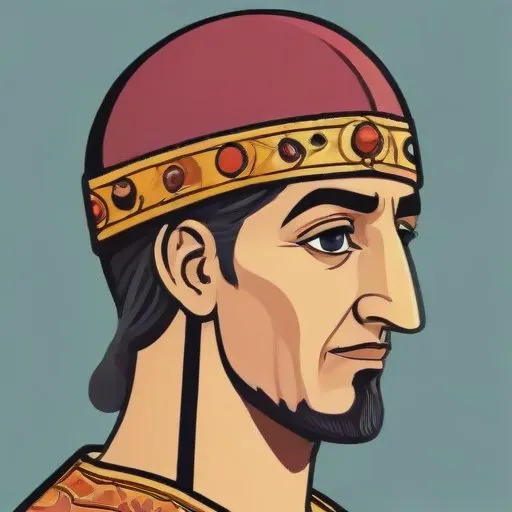
The Byzantine emperor who ruled from 1282 to 1328, known for his attempts to reform the empire's government and economy, and his conflicts with the Ottoman Turks.
Andronikos II Palaiologos, also known as Andronicus II Palaeologus, is remembered as the Byzantine emperor who reigned from 1282 to 1328, marking the beginning of the empire's final decline. His reign was marred by internal conflicts, territorial losses, and a series of unfortunate events that led to his eventual forced abdication.
Andronikos was born on March 25, 1259, in Nicaea, as the eldest surviving son of Michael VIII Palaiologos and Theodora Palaiologina. He was acclaimed co-emperor in 1261, after his father recovered Constantinople from the Latin Empire, and was formally crowned on November 8, 1272.
Following his father's death in 1282, Andronikos II became the sole emperor, and one of his earliest actions was to repudiate the union with the Papacy, which had been unpopular among the Orthodox clergy. However, he was unable to resolve the resulting schism within the clergy until 1310.
In 1283, Andronikos launched an expedition to Thessaly, which was ruled by John Doukas, in an attempt to reclaim the region for the Byzantine Empire. The expedition was led by the protovestiarios Michael Tarchaneiotes, but it ultimately ended in failure due to an epidemic that broke out, killing many of the soldiers, including Tarchaneiotes.
One of the most significant events of Andronikos' reign was the First Palaiologan Civil War, which was fought between Andronikos and his grandson, Andronikos III Palaiologos. The war lasted from 1321 to 1328 and ended with Andronikos II's forced abdication.
Andronikos II's reign was marked by a series of failures, including the loss of Anatolian territories to the Turks and the internal conflicts that plagued the empire. He was eventually forced to abdicate in 1328 and retired to a monastery, where he spent the remainder of his life.
Andronikos II's reign is significant in Byzantine history, as it marked the beginning of the empire's final decline. His failures in military campaigns and internal conflicts weakened the empire, making it vulnerable to external threats. Despite his efforts to reform the empire, Andronikos was ultimately unsuccessful in reversing its decline.
Born in 1332
The last ruler of the Byzantine Empire, who reigned from 1341 to 1376 and is known for his attempts to reform the empire and defend it against the Ottoman Turks. He was a skilled diplomat and strategist, but ultimately failed to save the empire from collapse.
Born in 1350
The last Byzantine emperor to rule from Constantinople, he's known for his efforts to unite the Eastern and Western churches and his writings on theology and politics.
Born in 1326
The founder of the Ottoman Empire's expansionist era, known for conquering much of the Balkans and establishing the Ottoman state as a dominant power in the region.
Born in 1447
The Ottoman Empire's eighth ruler, known for his military campaigns, administrative reforms, and cultural patronage, which led to a golden age of Ottoman architecture and art. He also oversaw the expulsion of Jews from Spain, offering them refuge in the Ottoman Empire.
Born in 1642
The Ottoman sultan who ruled from 1648 to 1687, known for his military campaigns that expanded the empire's borders, including the conquest of Crete and parts of Poland. He was also known for his cultural and architectural achievements, including the construction of several mosques and palaces.
Born in 1494
Ruling the Ottoman Empire at its peak, he expanded its borders, conquered Belgrade, and laid siege to Vienna, earning a reputation as a brilliant military strategist and statesman. He also codified laws and reformed the empire's administration.
