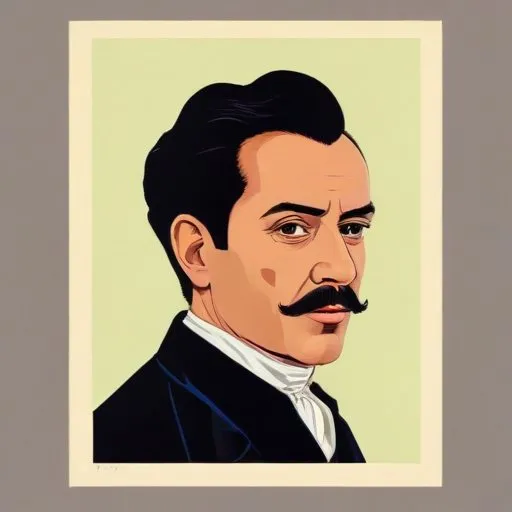
Manuel Maria Barbosa du Bocage: The Portuguese Neoclassic Poet
Manuel Maria Barbosa du Bocage, known simply as Bocage, was a Portuguese Neoclassic poet who gained fame in the late 18th century for his versatility and skill in writing various forms of poetry. He is particularly renowned for his Brazilian modinhas, short rhyming poems sung accompanied by a guitar, which became extremely popular during his time.
Early Life and Career
Born on September 15, 1765, in the Portuguese city of Setúbal, Bocage was the son of José Luís Soares de Barbosa and Mariana Joaquina Xavier l'Hédolis du Bocage, of French family. He began writing verses at a very young age and showed exceptional talent, earning him recognition as a prodigy. At 14, he left school and joined the 7th Infantry Regiment, but soon became disillusioned with garrison life and decided to enter the Portuguese navy.
Nautical Adventures and Romantic Escapades
Bocage's entry into the navy marked the beginning of a series of romantic adventures and nautical exploits. He proceeded to the Royal Marine Academy in Lisbon, but instead of focusing on his studies, he pursued romantic conquests and honed his skills in improvisation. His exceptional talent and retentive memory earned him a large following of admirers, who were captivated by his poetry and charisma.
Brazilian Modinhas and Poetic Fame
During this period, Bocage wrote numerous Brazilian modinhas, which became extremely popular in Portuguese society. These short poems, sung accompanied by a guitar, showcased his exceptional talent for improvisation and won him widespread recognition. His allegorical idyllic pieces, reminiscent of Watteau's and Boucher's paintings, further solidified his reputation as a master poet.
Appointment to the Portuguese India Navy
In 1786, Bocage was appointed guardamarinha in the Portuguese India navy, and he set sail for Goa via Brazil. However, upon arrival, he found himself disillusioned with the petty intrigue and lack of intellectual stimulation in the colony. The climate also took a toll on his health, leading to a serious illness.
Satirical Sonnets and Critique of the Portuguese Empire
During his time in Goa, Bocage wrote satirical sonnets that critiqued the decadence of the Portuguese Empire in Asia. He also penned poems addressed to Afonso de Albuquerque and D.
João de Castro, two prominent figures in Portuguese history. These poems showcased his wit and biting satire, which would become a hallmark of his literary style.
Legacy and Impact
Despite his short life, Bocage left an indelible mark on Portuguese literature. His poetry, marked by its versatility and skill, continues to inspire generations of writers and poets. His Brazilian modinhas, in particular, remain a beloved part of Portuguese cultural heritage.
Personal Life and Trivia
- Bocage used the pen name Elmano Sadino during the early years of his career.
- He was known for his exceptional memory, which allowed him to improvise verses with ease.
- He died on December 21, 1805, at the age of 40, leaving behind a legacy of poetic genius.
Bocage's life was a testament to the power of creativity and imagination. Through his poetry, he continues to inspire and captivate audiences to this day.
FAQ
What was Manuel Maria Barbosa du Bocages role in Portuguese literature?
Manuel Maria Barbosa du Bocage was a prominent Portuguese poet and author, known for his neoclassical style and his contributions to the development of Portuguese literature.
How did Manuel Maria Barbosa du Bocage contribute to the Portuguese Enlightenment?
Manuel Maria Barbosa du Bocage was a key figure in the Portuguese Enlightenment, using his writing to promote democratic ideals and challenge traditional authority.
What was Manuel Maria Barbosa du Bocages most notable work?
Manuel Maria Barbosa du Bocages most notable work is his poem Morte de Luís de Camões, which is considered a masterpiece of Portuguese literature.
How did Manuel Maria Barbosa du Bocages education influence his writing?
Manuel Maria Barbosa du Bocages education at the University of Coimbra gave him a strong foundation in classical literature, which influenced his writing style and themes.
Where did Manuel Maria Barbosa du Bocage study law?
Manuel Maria Barbosa du Bocage studied law at the University of Coimbra, where he earned his degree in 1778 and began his literary career.