


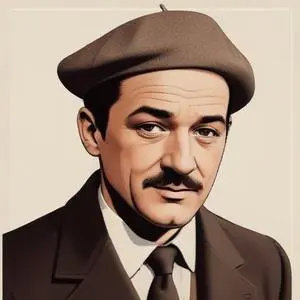
Acclaimed filmmaker behind the Oscar-winning adaptation of "Black Orpheus", a vibrant and poetic retelling of the Orpheus myth set in Rio de Janeiro during Carnival.
Marcel Camus, a French film director, is best known for his masterpiece, Orfeu Negro (Black Orpheus), which won the prestigious Palme d'Or at the 1959 Cannes Film Festival and the 1960 Academy Award for Best Foreign Language Film. This cinematic triumph catapulted Camus to international fame, leaving an indelible mark on the film industry.
Born on April 21, 1912, in Chappes, Ardennes, France, Camus initially pursued a career in art, intending to become an art teacher. However, World War II disrupted his plans, and he spent part of the war in a German prisoner-of-war camp. This experience would later influence his filmmaking style.
Following the war, Camus assisted prominent French filmmakers, including Jacques Feyder, Luis Buñuel, and Jacques Becker, honing his skills and preparing for his own directorial debut.
Camus's breakthrough film, Orfeu Negro, was a groundbreaking adaptation of the Greek myth of Orpheus and Eurydice, set against the vibrant backdrop of Carnaval in Rio de Janeiro. This visually stunning and musically captivating film resonated with audiences worldwide, earning Camus widespread acclaim.
He continued to explore Brazilian themes in his subsequent films, including Os bandeirantes (1960) and Bahia (1978). Although these films didn't replicate the success of Orfeu Negro, they demonstrated Camus's fascination with the rich cultural heritage of Brazil.
In the 1970s, Camus shifted his focus to television, directing several TV movies and series. One of his notable works during this period was Le Mur de l'Atlantique (The Atlantic Wall), a World War II comedy starring the renowned French comedian Bourvil.
Camus's personal life was marked by romantic relationships with two actresses from Orfeu Negro, Marpessa Dawn and Lourdes de Oliveira. He married de Oliveira and had two children, including the writer Jean-Christophe Camus.
Marcel Camus's contributions to French cinema and his exploration of Brazilian culture have left a lasting impact on the film industry. Orfeu Negro remains a timeless classic, celebrated for its innovative storytelling, captivating visuals, and memorable soundtrack.
Camus's legacy extends beyond his films, inspiring future generations of filmmakers and cementing his place as a pioneer in world cinema.
Marcel Camus passed away on January 13, 1982, in Paris, leaving behind a rich cinematic legacy that continues to captivate audiences today.
Born in 1889
A renowned French creative force, celebrated for his innovative and surreal works that blurred the lines between literature, art, and cinema, leaving an indelible mark on 20th-century culture.
Born in 1920
Visionary filmmaker behind surreal, poetic, and deeply personal cinematic masterpieces that blur the lines between reality and fantasy.
Born in 1912
A pioneering filmmaker who explored the human condition through visually stunning and psychologically complex movies, often focusing on alienation and social isolation.
Born in 1906
Acclaimed Italian filmmaker renowned for lavish, visually stunning productions that often explored themes of social class, morality, and the human condition. His cinematic masterpieces continue to influence filmmakers today.
Born in 1901
A renowned filmmaker and actor, known for directing poignant, neorealist classics like "Bicycle Thieves" and "Umberto D.", which still influence world cinema today.
94 Years Old
A pioneering filmmaker of the French New Wave, known for directing iconic films like "Jules and Jim" and "The 400 Blows", which redefined cinematic storytelling.
Born in 1920
French New Wave pioneer behind contemplative, visually stunning films that explore human relationships and morality, known for subtle storytelling and nuanced character studies.
96 Years Old
A French New Wave pioneer, known for crafting suspenseful, psychologically complex films that probed the darker aspects of human nature, often focusing on the bourgeoisie.
