


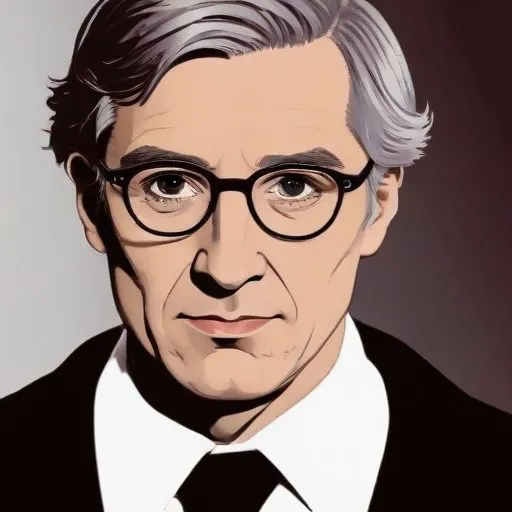
A French mathematician and computer scientist who made significant contributions to the development of formal language theory and its applications to computer science, particularly in the areas of automata theory and combinatorics on words.
Meet MarcelPaul Schtzenberger, a French mathematician and Doctor of Medicine who left an indelible mark on the fields of formal language, combinatorics, and information theory. His groundbreaking contributions have resulted in several notable theorems and objects bearing his name, including the Schutzenberger group and the Chomsky-Schtzenberger hierarchy.
Schtzenberger's first foray into academia was in the field of medicine, where he earned his doctorate in 1948 from the Faculté de Médecine de Paris. His doctoral thesis, which focused on the statistical study of biological sex at birth, was awarded the prestigious Baron Larrey Prize from the French Academy of Medicine.
Biologist Jaques Besson, who co-authored a paper with Schtzenberger on a biological topic, credits him with introducing statistical sequential analysis in French hospital practice. This pioneering work paved the way for future generations of medical professionals.
Schtzenberger's second doctorate, awarded in 1953 from Université Paris III, marked the beginning of his illustrious career in mathematics and computer science. His work in information theory was instrumental in shaping the field, and his influence can be seen in the development of formal linguistics and combinatorics.
Two theorems in formal linguistics, the Chomsky-Schtzenberger enumeration theorem and the Chomsky-Schtzenberger representation theorem, bear testament to his profound impact on the field. Additionally, the Schtzenberger theorem in combinatorics is a direct result of his tireless efforts.
Schtzenberger's views on evolution were unconventional, to say the least. He was vocal in his criticism of neo-Darwinism, a stance that elicited mixed reactions from his peers and critics. While some praised his courage in challenging prevailing theories, others criticized his views as unorthodox.
In the late 1940s, Schtzenberger was briefly married to the psychologist Anne Ancelin Schtzenberger. His great-grandfather, Paul Schtzenberger, was a notable figure in his own right.
Schtzenberger's contributions to mathematics, computer science, and medicine have left a lasting impact on these fields. His work continues to inspire future generations of scholars and researchers, ensuring that his legacy endures.
Through his groundbreaking research and controversial views, MarcelPaul Schtzenberger has cemented his place as one of the most fascinating and complex figures in the history of mathematics and science.
Born in 1906
A French mathematician and academic who made significant contributions to number theory, algebraic geometry, and the development of modern mathematics, leaving a lasting impact on the field.
Born in 1906
A renowned mathematician and academic who made significant contributions to abstract algebra, particularly in the development of modern algebraic geometry and topology. His work laid the foundation for many subsequent mathematical discoveries.
Born in 1915
Developed the theory of distributions, a fundamental concept in mathematics, and was awarded the Fields Medal in 1950 for his work. His contributions have had a lasting impact on modern mathematics and physics.
94 Years Old
A French mathematician who made significant contributions to algebraic geometry, number theory, and category theory, shaping modern mathematics and influencing many fields.
98 Years Old
A pioneer in algebraic geometry, revolutionizing the field with innovative ideas and abstract approaches, shaping modern mathematics and influencing generations of mathematicians.
96 Years Old
A pioneer in abstract algebra, this mathematician developed the theory of buildings, a fundamental concept in modern algebraic geometry, and was awarded the Abel Prize in 2008.
Born in 1904
A pioneer in algebraic topology, he developed influential theories and founded the Bourbaki group, revolutionizing modern mathematics.
Born in 1926
A renowned mathematician and academic, he is most known for his groundbreaking work in algebraic geometry and number theory, earning him a Fields Medal in 1954.
