


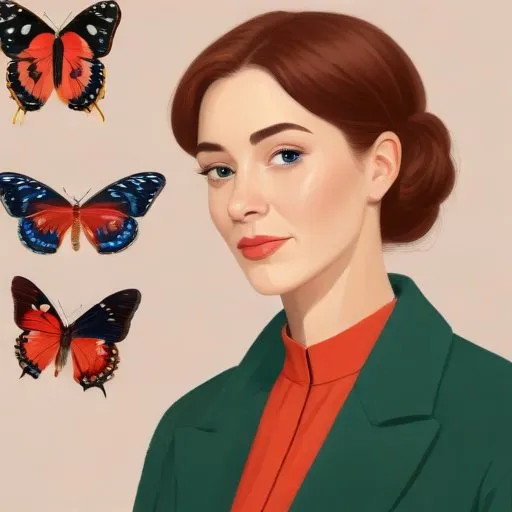
A pioneering female entomologist who traveled the world collecting and studying butterflies, leaving behind a treasure trove of detailed diaries and specimens. Her writings offer a unique glimpse into the life of a Victorian-era woman scientist.
Margaret Fountaine was a renowned Victorian lepidopterist, natural history illustrator, and diarist who made significant contributions to the field of entomology, particularly in the study of butterflies and moths. She is best known for her extensive travels, collecting and illustrating butterflies from around the world, and publishing numerous papers on her research.
Margaret Fountaine was born on May 16, 1862, in Norwich, England, to Reverend John Fountaine, a country clergyman, and Mary Isabella Lee. She was the eldest of seven children and was educated at home, where she developed a passion for natural history and drawing.
At the age of 16, Fountaine began keeping a diary, which became a lifelong habit. In her diary, she chronicled her travels, notes on butterfly behavior, and sketches of her specimens. Her fascination with butterflies took her to over 60 countries on six continents, where she collected and studied various species, often traveling alone and overcoming numerous challenges.
Fountaine's contributions to entomology were significant, with her research focusing on tropical butterfly lifecycles. She published numerous papers on her findings in scientific journals, including The Entomologists Record and Journal of Variation. Her work was highly regarded by her contemporaries, and her collection of over 22,000 butterfly specimens is now housed at the Norwich Castle Museum, known as the Fountaine-Neimy Collection.
In addition to her scientific pursuits, Fountaine was an accomplished natural history illustrator. Her four sketchbooks of butterfly lifecycles are held at the Natural History Museum in London. Her artistic talent and attention to detail helped her to accurately depict the intricate features of her specimens, making her illustrations highly valuable for scientific study.
In recognition of her contributions to entomology, the butterfly genus Fountainea was named in her honor. Her life's work has inspired generations of naturalists and scientists, and her legacy continues to be celebrated in the scientific community.
Margaret Fountaine's remarkable life and achievements serve as a testament to her passion, dedication, and pioneering spirit. Her contributions to the field of entomology continue to inspire and educate scientists and naturalists today.
Born in 1825
A British explorer who traveled to the Amazon rainforest and discovered over 8,000 species, including butterflies, beetles, and birds, and is known for his theory of mimicry in nature.
Born in 1823
A pioneering naturalist who discovered evolution through natural selection, independently of Charles Darwin, and contributed significantly to the field of biogeography.
Born in 1809
Developed the theory of evolution through natural selection, revolutionizing our understanding of life on Earth. This groundbreaking idea transformed the fields of biology, ecology, and beyond.
