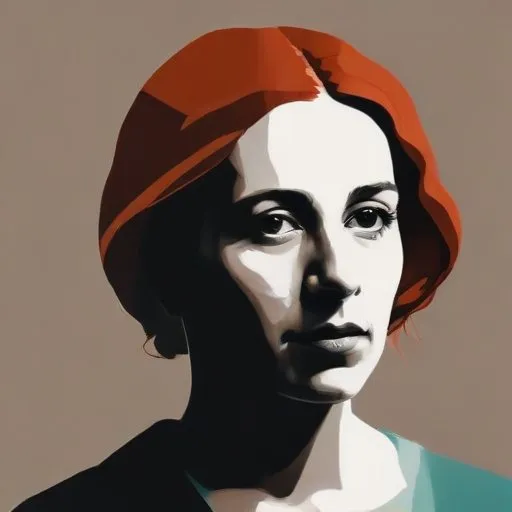
Margherita Piazzola Beloch: A Pioneering Mathematician in Algebraic Geometry and Beyond
A Trailblazer in a Male-Dominated Field
Margherita Piazzola Beloch is renowned for her groundbreaking contributions to algebraic geometry, algebraic topology, and photogrammetry, paving the way for future generations of female mathematicians. As one of the earliest women to make significant strides in these fields, Beloch's work continues to inspire and influence mathematicians to this day.
Early Life and Education
Born on July 12, 1879, in Frascati, Italy, Beloch was the daughter of
Karl Julius Beloch, a German historian, and Bella Bailey, an American. Her academic pursuits began at the Sapienza University of Rome, where she studied mathematics under the guidance of
Guido Castelnuovo. Her exceptional talent earned her a laureate degree in 1908, accompanied by the prestigious "dignità di stampa" award, which recognized her work as worthy of publication.
Academic Career and Achievements
Beloch's academic career was marked by numerous milestones. She began as an assistant to Guido Castelnuovo, a position she held until 1919. She then moved to Pavia and later to Palermo, where she worked under Michele De Franchis, a prominent figure in the Italian school of algebraic geometry. In 1924, Beloch completed her "libera docenza," a degree that enabled her to become a professor. Three years later, she was appointed as a full professor at the University of Ferrara, a position she held until her retirement in 1955.
Scientific Contributions
Beloch's research focused primarily on algebraic geometry, algebraic topology, and photogrammetry. Her work on the classification of algebraic surfaces led to significant discoveries, including the characterization of hyperelliptic surfaces of rank 2 by the presence of 16 rational curves. She also made notable contributions to the theory of skew algebraic curves.
Legacy and Impact
Margherita Piazzola Beloch's legacy extends far beyond her mathematical achievements. She broke barriers for women in academia, inspiring future generations to pursue careers in mathematics and science. Her work continues to influence contemporary research in algebraic geometry and related fields.
Personal Life and Marriage
Beloch married and took the surname Piazzolla. Little is known about her personal life, but her dedication to her work and her remarkable achievements speak volumes about her character and perseverance.
Conclusion
Margherita Piazzola Beloch's remarkable journey serves as a testament to her unwavering passion for mathematics and her unrelenting pursuit of knowledge. As a pioneering female mathematician, she has left an indelible mark on the world of algebraic geometry and beyond. Her legacy continues to inspire and motivate mathematicians and scientists around the world.
FAQ
What was Margherita Piazzola Belochs most significant mathematical contribution?
Margherita Piazzola Belochs most significant mathematical contribution was her work on algebraic geometry, particularly her development of the theory of algebraic curves and surfaces.
How did Margherita Piazzola Belochs work influence the development of mathematics?
Margherita Piazzola Belochs work had a significant impact on the development of mathematics, particularly in the areas of algebraic geometry and number theory, and paved the way for later breakthroughs in the field.
What was Margherita Piazzola Belochs role in promoting women in mathematics?
Margherita Piazzola Beloch was a pioneer for women in mathematics, advocating for greater opportunities and recognition for female mathematicians and inspiring future generations of women to pursue careers in mathematics.
What were Margherita Piazzola Belochs interests outside of mathematics?
Margherita Piazzola Beloch was an accomplished linguist and philologist, with a deep love of languages and literature, and was also an active advocate for social justice and womens rights.
What is Margherita Piazzola Belochs legacy in the world of mathematics?
Margherita Piazzola Belochs legacy is one of groundbreaking research, pioneering spirit, and inspiration to future generations of mathematicians, particularly women, around the world.