


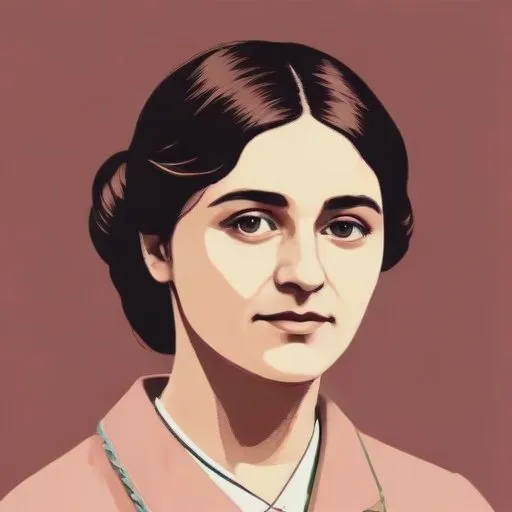
A pioneering female mathematician and physicist who made significant contributions to number theory and elasticity theory, particularly in the study of prime numbers and Fermat's Last Theorem.
Sophie Germain, a French mathematician, physicist, and philosopher, is renowned for her groundbreaking contributions to the field of mathematics, particularly in elasticity theory and Fermat's Last Theorem. Born on April 1, 1776, in Paris, France, Germain's work laid the foundation for mathematicians to explore these subjects for centuries to come.
Germain was born into a wealthy family, with her father, Ambroise-François, being a silk merchant and later a representative of the bourgeoisie to the États-Généraux. This exposure to politics and philosophy at a young age sparked her interest in intellectual pursuits. Germain's parents, however, did not initially encourage her academic endeavors, considering them unfeminine.
Undeterred, Germain sought education through books in her father's library, including works by Euler, and corresponded with famous mathematicians such as Lagrange, Legendre, and Gauss under the pseudonym Monsieur LeBlanc. This determination and self-directed learning enabled her to excel in mathematics, despite societal obstacles.
Germain's seminal work on elasticity theory led to her winning the grand prize from the Paris Academy of Sciences. Her paper, which explored the mathematical theory of elasticity, was a milestone in the field and paved the way for further research. Additionally, her work on Fermat's Last Theorem provided a foundation for future mathematicians to build upon.
Germain's contributions to mathematics were not limited to these areas. She also made significant progress in number theory, algebra, and geometry. Her papers on these subjects demonstrated her exceptional mathematical prowess and earned her recognition from prominent mathematicians of her time.
Despite facing prejudice against women in mathematics, Germain's work has had a lasting impact on the field. Her groundbreaking research on elasticity theory has applications in modern engineering, materials science, and physics. Her contributions to Fermat's Last Theorem have influenced generations of mathematicians, including Andrew Wiles, who finally solved the problem in 1994.
In recognition of her achievements, the Academy of Sciences established the Sophie Germain Prize in her honor. A street and a girls' school in Paris were also named after her, celebrating her legacy as a trailblazing mathematician and physicist.
Germain's work was not only driven by mathematical curiosity but also by philosophical inquiry. She believed that mathematics could be used to understand the natural world and that it held the key to unlocking the secrets of the universe.
Her philosophical stance was rooted in the idea that reason and intellect could overcome societal limitations. This conviction inspired her to persevere in the face of adversity, paving the way for future generations of women in mathematics and science.
"When a question is once asked, it is only a matter of time before it is answered."
This quote encapsulates Germain's unwavering dedication to the pursuit of knowledge and her conviction that intellectual curiosity could overcome any obstacle.
Born in 1749
Developed nebular hypothesis of the origin of the solar system and formulated Laplace's equation, a fundamental concept in mathematics and physics. He's considered the founder of celestial mechanics.
Born in 1752
Developed the theory of elliptic integrals, and his work on number theory laid the foundation for modern cryptography.
Born in 1777
A pioneer in mathematics and physics, he made major contributions to number theory, algebra, and electromagnetism, shaping our understanding of the natural world.
Born in 1736
Developed calculus, number theory, and celestial mechanics, making significant contributions to the fields of mathematics and astronomy.
Born in 1774
A French polymath who made significant contributions to the fields of physics, astronomy, and mathematics, particularly in the discovery of chromatic polarization and the Biot-Savart law.
Born in 1781
Developed mathematical tools to analyze probability and statistics, and made significant contributions to the fields of electricity and magnetism.
Born in 1789
Developed rigorous mathematical theories and introduced concepts like convergence and continuity, revolutionizing calculus and paving the way for modern mathematics.
Born in 1786
A mathematician and politician who made significant contributions to the development of electromagnetism and served as Prime Minister of France, advocating for social reform and education.
