


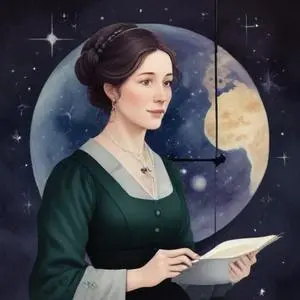
A pioneering female mathematician and astronomer who wrote influential books on celestial mechanics and was one of the first women to be recognized for her scientific contributions. Her work helped popularize complex scientific concepts for a broader audience.
Mary Somerville, a Scottish scientist and writer, is renowned for her groundbreaking contributions to the fields of mathematics and astronomy. Elected as one of the first female Honorary Members of the Royal Astronomical Society in 1835, alongside Caroline Herschel, Somerville's work had a profound impact on the development of modern science.
Born on December 26, 1780, at the manse of Jedburgh, Scotland, Somerville was the daughter of Vice-Admiral Sir William George Fairfax. Her childhood home was at Burntisland, Fife, where she developed a close relationship with her oldest brother Sam. Despite living in genteel poverty due to her father's meager naval pay, Somerville's family encouraged her intellectual pursuits.
Somerville's fascination with mathematics and astronomy led her to study the works of prominent scientists, including Pierre-Simon Laplace and Isaac Newton. Her groundbreaking book, On the Connexion of the Physical Sciences, published in 1834, showcased her exceptional understanding of celestial mechanics and was praised by the scientific community.
Somerville's achievements paved the way for women in science, inspiring future generations of female scientists. When John Stuart Mill organized a petition to grant women the right to vote, he ensured that Somerville's signature would be the first on the list. This testament to her influence is a reflection of her dedication to promoting women's rights and education.
Somerville's work demonstrated a deep understanding of the connections between various scientific disciplines. She believed that the natural world was governed by underlying laws and principles, and her writings reflected her fascination with the unity of knowledge.
Somerville's legacy extends beyond her scientific contributions. Somerville College, a college of the University of Oxford, was named in her honor, reflecting her embodiment of liberal values and academic excellence. In 2017, the Royal Bank of Scotland featured Somerville on their polymer 10 note, accompanied by a quote from her work On the Connection of the Physical Sciences.
Mary Somerville's remarkable life serves as a testament to the power of dedication, perseverance, and intellectual curiosity. Her achievements continue to inspire generations of scientists, writers, and individuals who dare to challenge conventional boundaries.
In the words of The Morning Post, "Whatever difficulty we might experience in the middle of the nineteenth century in choosing a king of science, there could be no question whatever as to the queen of science."
Born in 1750
First female astronomer to receive a salary, discovered several comets and double stars, and assisted her brother William in his astronomical observations.
Born in 1799
A pioneering fossil hunter who uncovered several groundbreaking dinosaur discoveries, including the first complete plesiosaur skeleton, significantly advancing our understanding of prehistoric life.
Born in 1815
Pioneering mathematician and computer scientist who wrote the first algorithm intended to be processed by a machine, and is often considered the first computer programmer. Her work on Charles Babbage's Analytical Engine envisioned its potential to go beyond mere calculation and perform any task that could be expressed in a series of steps.
Born in 1820
Pioneering nurse and statistician who revolutionized healthcare by introducing sanitation practices and data-driven decision making, becoming the founder of modern nursing.
Born in 1830
A reclusive poet who crafted innovative, enigmatic, and emotionally charged verse that continues to captivate readers with its unique style and profound insights.
Born in 1806
A renowned poet and translator of the Victorian era, celebrated for her romantic and socially conscious works, particularly the iconic love poems "Sonnets from the Portuguese".
Born in 1819
A renowned 19th-century English novelist and poet, celebrated for crafting complex, psychologically nuanced characters and exploring social issues in works like "Middlemarch" and "Silas Marner".
Born in 1830
A renowned Victorian-era poet and author, celebrated for her lyrical and symbolic poetry, particularly "The Goblin Market and Other Poems" and "The Prince's Progress".
