


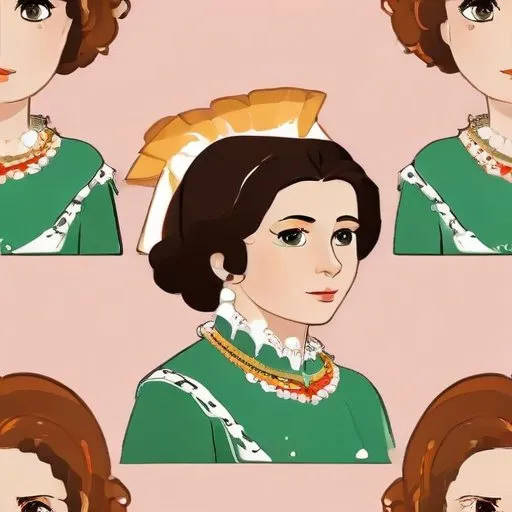
The Italian queen consort who reigned from 1878 to 1900, known for her strong support of the Italian unification and her charitable work, especially in the field of education.
Renowned for her intellectual curiosity, strong force of will, and captivating charm, Margherita of Savoy reigned as the Queen of Italy by marriage to her first cousin King Umberto I of Italy. As the mother of King Victor Emmanuel III of Italy, her legacy extends beyond her own remarkable life, shaping the course of Italian history.
Born on November 20, 1851, to Prince Ferdinand of Savoy, Duke of Genoa, and Princess Elisabeth of Saxony, Margherita's early life was marked by tragedy with the death of her father in 1855. Her mother's subsequent remarriage to Major Nicholas Bernoud, Marchese di Rapallo, did little to dampen Margherita's thirst for knowledge. Educated by Countess Clelia Monticelli di Casalrosso and her Austrian governess Rosa Arbesser, Margherita received a more advanced education than most princesses of her time, showcasing her innate intellectual curiosity.
In 1868, Margherita signed the wedding contract with her first cousin, Umberto, Prince of Piedmont, in the ballroom of the royal palace in Turin. The union was followed by a civilian and religious wedding ceremony the next day. As Crown Princess, Margherita settled in Naples with her husband, where she gave birth to Victor Emmanuel, Prince of Naples, later Victor Emmanuel III of Italy, on November 11, 1869.
Described as sensitive, proud, and possessing a strong force of will without being hard, Margherita was known for her captivating charm when she chose to display it. Physically, she was a tall, stately blonde, although not considered a beauty by conventional standards.
A patron of the arts and education, Margherita's intellectual curiosity extended to her support for various cultural and scientific institutions. Although her specific philosophical contributions are not well-documented, her advocacy for education and the arts reflects her commitment to the betterment of Italian society.
As the mother of King Victor Emmanuel III, Margherita's legacy extends beyond her own life, shaping the course of Italian history. Her emphasis on education and the arts continues to inspire generations, cementing her place as a pioneering figure in Italian society.
Through her remarkable life, Margherita of Savoy has left an indelible mark on Italian history, inspiring future generations with her intellectual curiosity, strong force of will, and captivating charm.
Born in 1841
The last queen of the Two Sicilies, known for her bravery during the Siege of Gaeta, where she helped care for wounded soldiers and maintained morale. She's a symbol of Italian unification.
Born in 1836
Last king of the Two Sicilies, ruling from 1859 to 1861, known for his brief and tumultuous reign that ended with the unification of Italy.
Born in 1751
King of the Two Sicilies from 1816 to 1825, known for his efforts to unify Italy and his role in the country's struggle for independence.
Born in 1863
Heir to the Austro-Hungarian throne whose assassination in Sarajevo sparked World War I. A symbol of imperial power and a catalyst for global conflict.
