


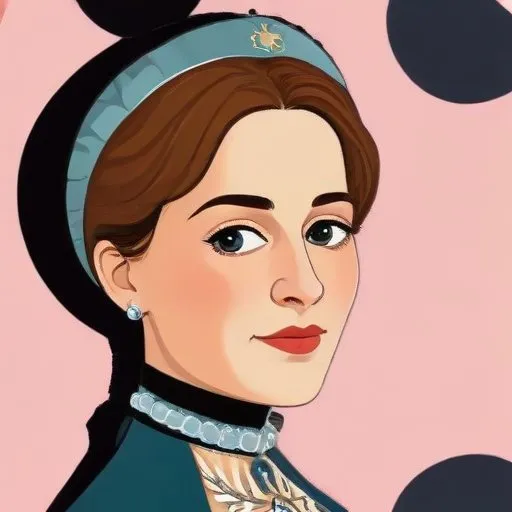
The last queen of the Two Sicilies, known for her bravery during the Siege of Gaeta, where she helped care for wounded soldiers and maintained morale. She's a symbol of Italian unification.
Maria Sophie of Bavaria, born on October 4, 1841, was the last queen consort of the Kingdom of the Two Sicilies, reigning alongside her husband, Francis II. She is best known for her bravery and determination during the tumultuous period of Italian unification, earning her the nickname "the Heroine of Gaeta."
Maria Sophie was born at Possenhofen Castle in Possenhofen, Kingdom of Bavaria, to Duke Maximilian Joseph in Bavaria and Princess Ludovika of Bavaria. She was the sixth of ten children and one of the eight that survived to adulthood. Her childhood, shared between Possenhofen Castle and the Herzog-Max-Palais in Munich, was marked by freedom and simplicity.
At the age of 16, Maria Sophie's hand was sought by Francis II of the Two Sicilies, the eldest son of King Ferdinand II of the Two Sicilies. The marriage was political, intended to strengthen ties with the Emperor of Austria, Franz Josef I. After undergoing treatments to induce menses and learning Italian, Maria Sophie was married by proxy and traveled to Bari, where she was formally married to Francis II on February 3, 1859.
Within a year of her marriage, Francis II ascended to the throne, and Maria Sophie became queen of the Kingdom of the Two Sicilies. However, their reign was short-lived, as the kingdom was soon threatened by the forces of Giuseppe Garibaldi and the Piedmontese army. In September 1860, the Garibaldine troops began their march towards Naples, and Maria Sophie played a crucial role in organizing the defense of the kingdom.
Despite being vastly outnumbered and outgunned, Maria Sophie showed remarkable bravery, visiting troops, and providing moral support to her husband. Her actions earned her the respect and admiration of her people, as well as the nickname "the Heroine of Gaeta."
After the fall of the Kingdom of the Two Sicilies in 1861, Maria Sophie and her husband were forced into exile. They initially settled in Rome, where they lived under the protection of the Pope, and later moved to Austria.
Maria Sophie spent the rest of her life in relative seclusion, dedicating herself to her family and charitable works. She died on January 19, 1925, at the age of 83, in Munich, Bavaria.
Maria Sophie's bravery and determination during the tumultuous period of Italian unification have left a lasting legacy. She remains a revered figure in Italian history, and her story has inspired generations of women.
Through her life and reign, Maria Sophie proved that women could be strong leaders, capable of inspiring loyalty and devotion in their people. Her story serves as a testament to the power of courage and determination in the face of adversity.
Born in 1830
The longest-reigning ruler of Austria-Hungary, presiding over a vast empire that spanned across Central Europe, and remembered for his role in shaping European history through diplomacy and war.
Born in 1786
The King of Bavaria who commissioned the iconic Neuschwanstein Castle, a fairytale-like palace that inspired the Disney castle, and was a patron of the arts, supporting Richard Wagner's operas.
