


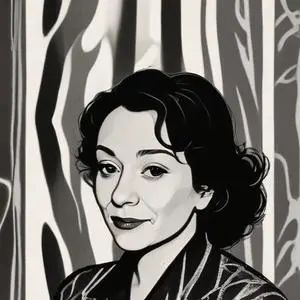
A French novelist, screenwriter, and director celebrated for her avant-garde and introspective works, often exploring themes of love, identity, and human relationships. Her writing style is characterized by simplicity, clarity, and emotional depth.
Renowned for her innovative and provocative writing style, Marguerite Duras was a French novelist, playwright, screenwriter, essayist, and experimental filmmaker who left an indelible mark on modern literature and cinema. Her critically acclaimed script for the film Hiroshima mon amour (1959) earned her a nomination for Best Original Screenplay at the Academy Awards.
Born Marguerite Donnadieu on April 4, 1914, in Gia Dinh, Cochinchina, French Indochina (now Vietnam), Duras' early life was marked by turmoil and displacement. Her parents, Marie and Henri Donnadieu, were teachers from France who had met in Gia Dinh High School. The family struggled financially, and her father's illness forced them to return to France, where he eventually passed away in 1921.
Between 1922 and 1924, Duras and her family lived in France, where she pursued her education. She successfully passed the first part of the baccalaureate with Vietnamese as a foreign language and later moved back to French Indochina. In 1931, she returned to France, graduating with a degree in public law in 1936. During this period, she also took classes in mathematics and began honing her writing skills.
Duras' literary career took off in the 1940s, with the publication of her first novel, L'Impudiante (1943). Her subsequent works, such as The Sea Wall (1950) and The Lover (1984), solidified her reputation as a bold and innovative writer. Her writing often explored themes of love, identity, and the human condition, set against the backdrop of colonialism and war.
In the 1960s, Duras expanded her creative horizons, experimenting with film. Her script for Hiroshima mon amour, directed by Alain Resnais, earned her an Academy Award nomination. She continued to push boundaries in her filmmaking, exploring themes of memory, trauma, and the human experience.
Marguerite Duras' groundbreaking work has inspired generations of writers, filmmakers, and artists. Her distinctive writing style, which blended poetry and prose, has influenced authors such as Jean-Luc Godard and W.G. Sebald. Her legacy extends beyond literature and film, with her pioneering spirit and courage to challenge societal norms continuing to inspire and provoke.
Duras' writing was deeply influenced by her philosophical interests, particularly existentialism and feminism. Her work often explored the tension between individual freedom and societal constraints, as well as the complexities of human relationships.
Marguerite Duras' pioneering spirit and provocative writing style have had a lasting impact on modern society. Her work continues to inspire writers, filmmakers, and artists, and her legacy serves as a testament to the power of creative expression to challenge and transform.
Throughout her life, Marguerite Duras remained committed to her craft, producing a body of work that continues to captivate and inspire audiences around the world. Her innovative spirit, philosophical depth, and literary genius have cemented her place as one of the most important writers of the 20th century.
95 Years Old
A pioneer of French New Wave cinema, known for experimental and provocative films that challenged traditional narrative structures and explored themes of politics, philosophy, and social commentary.
94 Years Old
A pioneering filmmaker of the French New Wave, known for directing iconic films like "Jules and Jim" and "The 400 Blows", which redefined cinematic storytelling.
Born in 1920
French New Wave pioneer behind contemplative, visually stunning films that explore human relationships and morality, known for subtle storytelling and nuanced character studies.
96 Years Old
A French New Wave pioneer, known for crafting suspenseful, psychologically complex films that probed the darker aspects of human nature, often focusing on the bourgeoisie.
Born in 1922
Pioneering filmmaker behind avant-garde and intellectually charged movies that explored the human condition, often blurring the lines between reality and fantasy. His unconventional narrative styles and exploration of memory, time, and identity continue to influence contemporary cinema.
Born in 1905
Existentialist philosopher and playwright who argued that humans have complete freedom to choose their actions and create their own meaning in life, influencing modern thought on morality and individual responsibility.
Born in 1908
A pioneering feminist philosopher who wrote extensively on ethics, politics, and gender, famously arguing that "one is not born, but rather becomes, a woman."
93 Years Old
French New Wave pioneer behind films like "Elevator to the Gallows" and "Murmur of the Heart", known for his lyrical and introspective storytelling style.
