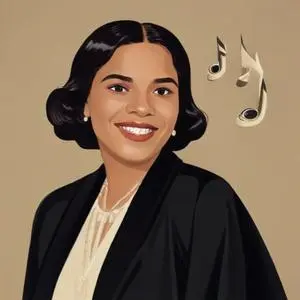
Marian Anderson: A Voice for Equality and Justice
A Trailblazing Contralto
Marian Anderson was a renowned American contralto, celebrated for her powerful, rich voice and her tireless fight against racial prejudice in the music industry. She is famously known for her iconic performance on the steps of the Lincoln Memorial in 1939, which became a symbol of the struggle for African American artists to overcome racial barriers.
Early Life and Education
Anderson was born on February 27, 1897, in Philadelphia, Pennsylvania, to John and Annie Anderson. From a young age, she showed a talent for singing and began performing in her church choir. She pursued her passion for music at the South Philadelphia High School and later at the New York City's Juilliard School of Music.
A Career of Firsts
Anderson's professional career spanned over four decades, during which she achieved numerous milestones. In 1925, she made her concert debut at Carnegie Hall, followed by performances with leading orchestras in major concert and recital venues throughout the United States and Europe.
- In 1939, she became the first African American to perform at the Daughters of the American Revolution's Constitution Hall, after being initially denied due to racial segregation.
- In 1955, she made history as the first African American singer to perform at the Metropolitan Opera.
- In 1963, she sang at the March on Washington for Jobs and Freedom, a pivotal event in the Civil Rights Movement.
Philosophical Contributions and Beliefs
Anderson's life was guided by her strong sense of justice and equality. She believed that music had the power to bring people together and transcend racial boundaries. Her perseverance in the face of discrimination inspired generations of African American artists to strive for excellence and fight for their rights.
Awards and Honors
Anderson's contributions to music and social justice were recognized with numerous awards and honors, including:
- The Presidential Medal of Freedom (1963)
- The Congressional Gold Medal (1977)
- The Kennedy Center Honors (1978)
- The National Medal of Arts (1986)
- A Grammy Lifetime Achievement Award (1991)
Legacy and Impact
Marian Anderson's legacy extends far beyond her remarkable music career. She played a significant role in breaking down racial barriers in the entertainment industry, paving the way for future generations of African American artists. Her courage and determination continue to inspire people around the world, making her a true icon of American cultural history.
Personal Milestones and Key Life Events
Anderson's personal life was marked by significant events that shaped her character and career. In 1943, she married Orpheus H. Fisher, an architectural engineer, and later adopted a son, James. She also worked as a delegate to the United Nations Human Rights Committee and as a Goodwill Ambassador for the United States Department of State, giving concerts worldwide.
Influence on Modern Society
Marian Anderson's impact on modern society is multifaceted. She has inspired countless musicians, artists, and civil rights activists to strive for excellence and fight for social justice. Her legacy continues to resonate in the music industry, with many artists citing her as a source of inspiration and courage.
Conclusion
Marian Anderson's remarkable life and career serve as a testament to the power of determination, hard work, and courage in the face of adversity. Her voice, both as a singer and as a symbol of resistance against racial prejudice, continues to inspire and uplift people around the world.
FAQ
What was Marian Andersons most notable achievement in music?
Marian Anderson was an American singer, celebrated for her powerful, contralto voice and historic performance at the Lincoln Memorial in 1939, which helped to break down racial barriers in the arts.
How did Marian Andersons early life influence her music career?
Andersons early life in Philadelphia and her training at the Juilliard School in New York City laid the foundation for her later success as a concert singer and advocate for racial equality.
What was Marian Andersons signature singing style?
Andersons rich, velvety voice, precise phrasing, and emotional intensity earned her a reputation as one of the greatest singers of her time, with a repertoire spanning classical music, spirituals, and folk songs.
How did Marian Andersons music career impact the Civil Rights Movement?
Andersons performances and advocacy helped to advance the cause of racial equality, inspiring generations of artists and activists, including Martin Luther King Jr.
What legacy did Marian Anderson leave on American music?
Marian Andersons trailblazing career and legacy continue to inspire American musicians, particularly African American artists, and remain a powerful symbol of the transformative power of music to overcome social and racial barriers.