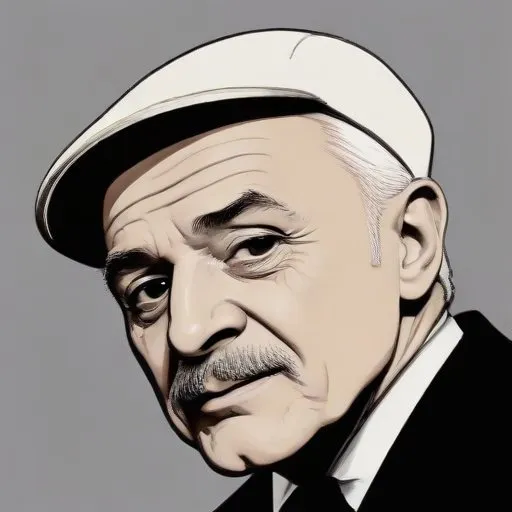
Mario Monicelli: A Maestro of Italian Comedy
Career Highlights and Major Works
Mario Monicelli is renowned for his exceptional contribution to the world of Italian cinema, particularly in the genre of commedia all'italiana (Italian-style comedy). With a career spanning over six decades, he is regarded as one of the most prolific and influential filmmakers of his time, having directed over 60 films and receiving six Oscar nominations.
Early Life and Education
Born on May 16, 1915, in Rome, Italy, Monicelli was raised in an upper-class family from Ostiglia, a town in the province of Mantua, in the Northern Italian region of Lombardy. His family, comprising of five children, was steeped in literary and journalistic traditions, with his father, Tomaso Monicelli, being a journalist, and his older half-brother, Giorgio, working as a writer and translator.
Foundations of a Cinematic Career
During his university days in Milan, Monicelli co-founded the newspaper Camminare with friends Riccardo Freda, Remo Cantoni,
Alberto Lattuada, Alberto Mondadori, and Vittorio Sereni. As a film critic, he wrote columns for Camminare, showcasing his critical perspective on Italian films while praising American and French cinema. This experience, although short-lived due to the fascist regime's disapproval of the publication's left-wing ideas, laid the foundation for his future success in the film industry.
Philosophical Contributions and Beliefs
Monicelli's cinematic style was deeply rooted in his anti-fascist sentiments, which he subtly expressed through his films. His work often critiqued the social and political landscape of post-war Italy, while maintaining a lighthearted and humorous tone. He believed in the power of comedy to comment on the human condition, making him a pioneer of the commedia all'italiana genre.
Awards and Honors
Throughout his illustrious career, Monicelli received numerous accolades, including the Golden Lion for his lifetime achievement, six Academy Award nominations, and several David di Donatello Awards.
Major Works and Innovations
Some of Monicelli's most notable films include:
- The Great War (1959), a satirical comedy that won the Golden Lion at the Venice Film Festival
- The Organizer (1963), a comedy-drama that earned him an Academy Award nomination
- My Friends (1975), a comedy that drew inspiration from his own childhood experiences in Tuscany
- The Audience (1971), a satirical comedy that critiques the Vatican's power structure
Influence on Modern Society
Monicelli's films not only reflected the societal changes of post-war Italy but also influenced the country's cultural landscape. His work continues to inspire new generations of filmmakers, writers, and comedians, cementing his legacy as a master of Italian comedy.
Personal Milestones and Key Life Events
Monicelli passed away on November 29, 2010, leaving behind a rich cinematic heritage. Throughout his life, he remained humble and committed to his craft, always pushing the boundaries of comedy and social commentary.
Legacy and Comparative Analysis
Mario Monicelli's impact on Italian cinema is undeniable, with his films continuing to delight audiences worldwide. His unique blend of wit, satire, and social commentary has earned him a place alongside other celebrated Italian filmmakers such as
Federico Fellini and
Vittorio De Sica.
FAQ
What was Mario Monicellis contribution to Italian neorealism?
Mario Monicelli was a prominent Italian film director who made significant contributions to the neorealist movement. His films often explored themes of social inequality, poverty, and human struggle, reflecting the harsh realities of post-war Italy.
What is Mario Monicellis most famous film?
Mario Monicellis most famous film is Big Deal on Madonna Street, a comedy-drama that satirizes the Italian economy and society of the 1950s. The film won the Academy Award for Best Foreign Language Film in 1959.
How did Mario Monicellis films reflect Italian society?
Mario Monicellis films often reflected the social and economic realities of post-war Italy, critiquing issues such as poverty, corruption, and social inequality. His films provided a commentary on the state of Italian society, sparking public debate and discussion.
What awards did Mario Monicelli receive for his contributions to Italian cinema?
Mario Monicelli received numerous awards for his contributions to Italian cinema, including multiple Academy Award nominations, Golden Lion awards at the Venice Film Festival, and the European Film Award for Lifetime Achievement.
What was Mario Monicellis role in shaping Italian comedy?
Mario Monicelli played a significant role in shaping Italian comedy, creating a new style of humor that was both satirical and poignant. His films often balanced humor with social commentary, influencing a generation of Italian comedians and filmmakers.