


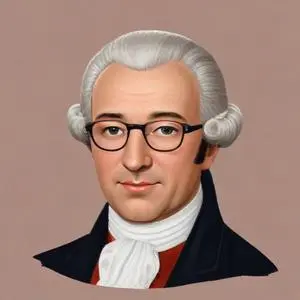
A French Enlightenment thinker who developed the concept of social choice theory and the Condorcet method, a voting system designed to produce a fair outcome.
Marquis de Condorcet, a French mathematician and political economist, is revered for his profound contributions to the Age of Enlightenment, advocating for free markets, public education, constitutional government, and equal rights for all races and genders. His ideals epitomize the spirit of Enlightenment rationalism, earning him the reputation as the last witness of this pivotal era.
Born on September 17, 1743, in Ribemont, France, Condorcet was fatherless from a young age and was raised by his devoutly religious mother, who dressed him as a girl until he was eight years old. Despite these unusual circumstances, he demonstrated exceptional intellectual abilities from an early age.
Condorcet was educated at the prestigious Jesuit College in Reims and later at the Collège de Navarre in Paris, where he excelled in mathematics and gained recognition for his talents. His analytical mind caught the attention of renowned mathematicians Jean le Rond d'Alembert and Alexis Clairaut, under whom he would later study.
In 1765, Condorcet published his groundbreaking work, "Essai sur le calcul intégral," which catapulted him to fame as a mathematician. This publication marked the beginning of a prolific career, with subsequent papers solidifying his position in the scientific community.
In 1769, he was elected to the Académie royale des Sciences, a testament to his growing influence. His work in integral calculus, published in 1772, further cemented his reputation as a leading mathematician of his time.
Condorcet's friendship with Jacques Turgot, a prominent French economist, had a profound impact on his work. Turgot's influence led Condorcet to explore the realm of economics, and he became an ardent advocate for free markets and laissez-faire policies.
Despite his tragic fate, Condorcet's ideas have had a lasting impact on modern society. His work in mathematics, economics, and philosophy continues to inspire scholars and policymakers alike.
As the last witness of the Enlightenment, Condorcet's legacy serves as a beacon, reminding us of the power of rational inquiry and the importance of promoting education, equality, and individual liberty.
In conclusion, Marquis de Condorcet's remarkable life and work serve as a testament to the enduring power of reason, liberty, and equality. His ideals continue to inspire generations, reminding us of the importance of promoting education, social justice, and individual freedom.
Born in 1694
A witty and insightful 18th-century writer and philosopher who used satire to critique societal norms and advocate for reason, tolerance, and human rights.
Born in 1712
A pioneering thinker who shaped modern democracy and education with his ideas on social contracts, general will, and the importance of early childhood education. His writings influenced the French Revolution and modern political thought.
Born in 1724
Developed influential philosophical frameworks, such as the Critique of Pure Reason, that shaped modern Western thought on ethics, morality, and human understanding.
61 Years Old
A lawyer and politician who served in the U.S. House of Representatives from 1987 to 1997, known for his moderate Republican views and advocacy for environmental issues.
Born in 1737
A founding father of American democracy, he penned influential writings that fueled the American Revolution and shaped modern democracy. His ideas still resonate in contemporary politics.
Born in 1632
A 17th-century thinker who laid the groundwork for modern democracy, arguing that governments derive their power from the people and that individuals have inherent rights to life, liberty, and property.
Born in 1689
A French lawyer and philosopher who developed the concept of separation of powers, which divides a government into legislative, executive, and judicial branches to prevent abuse of power. His ideas greatly influenced modern democracy.
Born in 1743
A radical Jacobin leader who advocated for the execution of King Louis XVI and was a key figure in the Reign of Terror during the French Revolution, known for his extreme views and assassination in his bathtub.
