


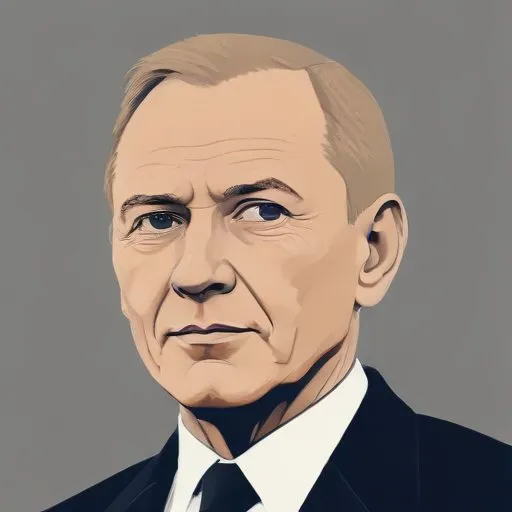
Estonian historian and politician who served as Prime Minister of Estonia, leading the country's transition from Soviet rule to independence and implementing free-market reforms. He's known for his role in Estonia's rapid modernization and digitalization.
Mart Laar, a renowned Estonian politician and historian, is credited with spearheading Estonia's rapid economic development during the 1990s. As the Prime Minister of Estonia from 1992 to 1994 and again from 1999 to 2002, Laar implemented sweeping reforms that transformed the country's economic landscape.
Laar was born on 22 April 1960 in Viljandi, Estonia. He pursued his passion for history at the University of Tartu, graduating in 1983. Laar went on to earn his master's degree in philosophy and his doctorate in history in 2005. Prior to entering politics, he taught history in Tallinn and served as president of several historical societies, including the Council of Historians of the Foundation of the Estonia Inheritance and the Estonian Students Society.
Laar's political career began when he joined the conservative Pro Patria Union party, which later merged with the Res Publica Party in 2006. In 1992, he was elected Prime Minister by the Riigikogu, Estonia's parliament. During his first term, Laar introduced a flat tax, privatized national industries, and abolished tariffs and subsidies, stabilizing the economy and balancing the budget.
Laar's radical reforms earned Estonia the distinction of being the first country in Europe to introduce a flat tax. His government's efforts to privatize national industries and liberalize trade policies attracted foreign investment and spurred economic growth. Estonia's rapid development during this period has been dubbed the "Estonian economic miracle."
Laar's historical background and philosophical pursuits have influenced his political beliefs. He has written extensively on Estonian and Soviet history, including the book "War in the Woods: Estonia's Struggle for Survival, 1944-1956," which explores the Forest Brothers anti-Soviet resistance movement. Laar's writings reflect his commitment to individual freedom and limited government intervention.
Laar's tenure as Prime Minister was marked by significant personal and political milestones. In 1994, he was defeated in a no-confidence vote due to scandals involving arms deals and corruption allegations. However, he returned to politics in 1999, serving as Prime Minister until 2002. In 2011, he became Minister of Defence, a position he held until his resignation in 2012 due to health reasons.
Laar's economic reforms have had a lasting impact on modern Estonian society. His policies have encouraged entrepreneurship, fostered innovation, and increased economic freedom. Estonia's rapid development has served as a model for other post-Soviet states and emerging economies.
Laar's economic reforms and legacy are often compared to those of other prominent European leaders, such as Margaret Thatcher and Václav Klaus. While Laar's policies were more radical and far-reaching, his commitment to limited government intervention and individual freedom aligns with the principles of these influential figures.
Laar has received numerous awards and honors for his contributions to Estonian politics and history. In 2013, he was appointed chairman of the supervisory board of the Bank of Estonia, a position he holds to this day.
Mart Laar's influence extends beyond politics to the fields of history and economics. His writings on Estonian history have contributed significantly to the country's academic and cultural discourse. His economic reforms have inspired a new generation of policymakers and scholars, cementing his legacy as a visionary leader and scholar.
72 Years Old
A Swedish-Estonian journalist and politician who served as the 4th President of Estonia, known for his efforts to promote e-government and digitalization in the country. He's a strong advocate for a free and open internet.
70 Years Old
Estonia's first Prime Minister to serve two consecutive terms, he led the country's digital revolution, making Estonia a global leader in e-government and digital innovation.
47 Years Old
The 16th Prime Minister of Estonia, serving from 2014 to 2016, known for his efforts to modernize the country's economy and digital infrastructure. He's also a strong advocate for e-government and digitalization.
48 Years Old
The 42nd Mayor of Tallinn, Estonia's capital, who served from 2005 to 2007 and later became the country's Prime Minister from 2016 to 2021, known for his efforts to strengthen Estonia's economy and digital infrastructure.
56 Years Old
The first female President of Estonia, serving from 2016 to 2021, known for her strong advocacy for climate action, digitalization, and e-government. She has been a vocal critic of authoritarianism and a champion of liberal democracy.
78 Years Old
The first Estonian to hold a high-ranking position in the European Commission, known for his efforts to modernize and integrate Estonia into the European Union. He played a key role in Estonia's accession to the EU and the eurozone.
86 Years Old
Estonian geographer and politician who served as the 10th Prime Minister of Estonia, known for his role in the country's transition to independence from Soviet rule. He's also a prominent environmentalist and advocate for sustainable development.
83 Years Old
Estonian physician and politician who served as the Minister of Health and Labour from 1999 to 2002, known for his healthcare reforms and contributions to Estonia's EU accession.
