


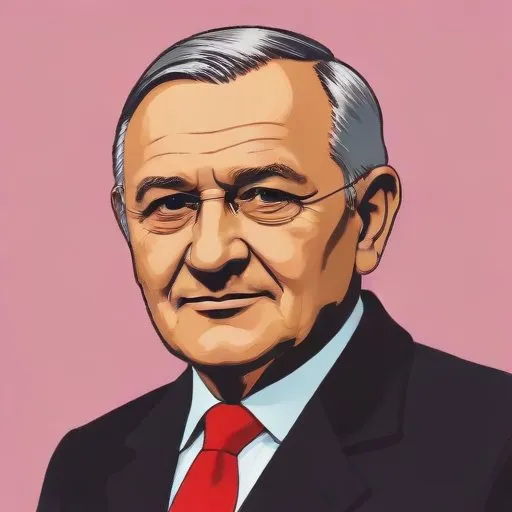
The second President of the Czech Republic, a vocal advocate for free market economics and Euroscepticism, known for his strong opinions on climate change and European integration.
Vclav Klaus is a name synonymous with Czech politics, economics, and leadership. As the second president of the Czech Republic, serving from 2003 to 2013, Klaus left an indelible mark on the country's development and growth.
Born on June 19, 1941, in Prague, during the Nazi occupation, Klaus grew up in the Vinohrady neighborhood. He claims to have helped build barricades during the Prague uprising in May 1945, at the tender age of three. Klaus pursued higher education at the University of Economics in Prague, graduating in 1963.
Klaus's career took off in the post-Communist era, when he became the Minister of Finance in the government of national unity in 1989. In 1991, he co-founded the Civic Democratic Party (ODS), which became a dominant force in Czech politics. Klaus's leadership prowess earned him the position of Prime Minister from 1992 to 1997, and later, the presidency of the Chamber of Deputies from 1998 to 2002.
In 2003, Klaus was elected President of the Czech Republic, a position he held until 2013. His presidency was marked by controversies surrounding his strong opinions on issues like global warming denial and Euroscepticism. A highly debated amnesty declared in his final months in office led to his indictment by the Czech Senate on charges of high treason.
Klaus's political views have been referred to as "Klausism." His leadership style, which blends economic liberalism with conservative values, has left a lasting impact on Czech politics. Although Klaus withdrew from active politics in 2013, he continues to influence domestic and foreign policy issues through his writings and public statements.
Klaus is a strong advocate for economic liberalism, individual freedom, and limited government intervention. He has been vocal about his skepticism towards global warming and the European Union, earning him both praise and criticism from international leaders and scholars.
Klaus has been married to Livia Klausová since 1968, and they have two sons, Václav and Jan. Despite controversies surrounding his presidency, Klaus remains a prominent figure in Czech politics, known for his charisma and unwavering commitment to his beliefs.
Klaus's leadership has had a profound impact on modern Czech society, shaping the country's economic and political landscape. His views on globalization, European integration, and climate change continue to influence contemporary debates and policy decisions.
Klaus is an avid reader and has a passion for classical music. He has been known to play the piano and has even performed with the Czech Philharmonic Orchestra.
"The greatest threat to freedom is not communism, but the concept of the 'common good'."
"We must not forget that the European Union is a bureaucratic machine, and bureaucracy is the enemy of freedom."
Vclav Klaus's life and work serve as a testament to the power of individual leadership and conviction. His legacy continues to shape Czech politics and inspire new generations of leaders, thinkers, and citizens.
90 Years Old
A Czech poet, playwright, and politician who led the country's transition from communism to democracy, and is known for his advocacy of human rights and individual freedom.
Born in 1921
A Slovak politician who led a brief, failed attempt to reform communism in Czechoslovakia during the Prague Spring of 1968, known for his efforts to introduce democratic reforms.
