


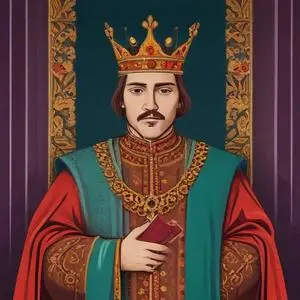
Renaissance-era king who ruled Hungary and Croatia, known for his military campaigns, cultural achievements, and patronage of arts and education. He transformed his kingdom into a major power in Central Europe.
Matthias Corvinus, also known as Matthias I, is renowned for his remarkable reign as King of Hungary and Croatia from 1458 to 1490, and his brief tenure as King of Bohemia from 1469 to 1490. During his reign, he implemented significant military, economic, and cultural reforms, earning him the reputation as one of the most influential rulers of the Renaissance era.
Matthias Corvinus was born on February 23, 1443, to John Hunyadi, Regent of Hungary, and his wife, Elizabeth Szilágyi. After his father's death in 1456, Matthias and his older brother, Ladislaus Hunyadi, were imprisoned on the orders of King Ladislaus the Posthumous in 1457. Ladislaus Hunyadi was executed, sparking a rebellion that forced King Ladislaus to flee Hungary. In 1458, Matthias' uncle, Michael Szilágyi, persuaded the Estates to proclaim the 14-year-old Matthias as king.
Matthias Corvinus is celebrated for his military prowess and strategic diplomacy. He waged wars against the Czech mercenaries who dominated Upper Hungary (present-day Slovakia and Northern Hungary) and against Frederick III, Holy Roman Emperor, who claimed Hungary for himself. In 1463, Matthias signed a peace treaty with Frederick III, acknowledging the Emperor's right to style himself King of Hungary. The Emperor returned the Holy Crown of Hungary, with which Matthias was crowned on April 29, 1464.
Matthias also intervened in the Ottoman-Hungarian Wars, attempting to reconquer territories occupied by the Ottoman Empire. Although he realized he could expect little aid from the Christian powers, he continued to resist the Ottomans, seizing fortresses in Bosnia in 1464.
During his reign, Matthias Corvinus introduced several reforms, including the establishment of a standing army, the creation of a centralized bureaucracy, and the promotion of education and culture. He invited scholars and artists from Italy to Hungary, fostering a Renaissance-era cultural rebirth in the region.
Matthias' legacy extends beyond his military and administrative achievements. He encouraged the development of trade, commerce, and infrastructure, stimulating economic growth in Hungary and Croatia. The Corvinus Library, founded by Matthias in 1476, became one of the largest and most renowned libraries of the Renaissance.
Matthias Corvinus was known for his strong personality, intelligence, and charm. He was married twice, first to Elizabeth of Celje and then to Beatrice of Naples. His relationships with his wives and mistresses were often tumultuous, with some historians suggesting that he was responsible for the murder of his first wife.
Despite his personal controversies, Matthias Corvinus remains an important figure in Hungarian and Croatian history, celebrated for his vision, leadership, and cultural achievements. His reign is regarded as the "Golden Age" of the Hungarian Renaissance, and his legacy continues to inspire and influence generations.
Through his remarkable reign, Matthias Corvinus left an indelible mark on Hungarian and Croatian history, shaping the course of the Renaissance and inspiring future generations.
Born in 1262
King of Hungary and Croatia from 1272 to 1290, known for his tumultuous reign marked by power struggles, wars, and a decline in royal authority.
Born in 1609
King of Denmark and Norway from 1648 to 1670, known for establishing absolute monarchy and modernizing Denmark's administration.
