


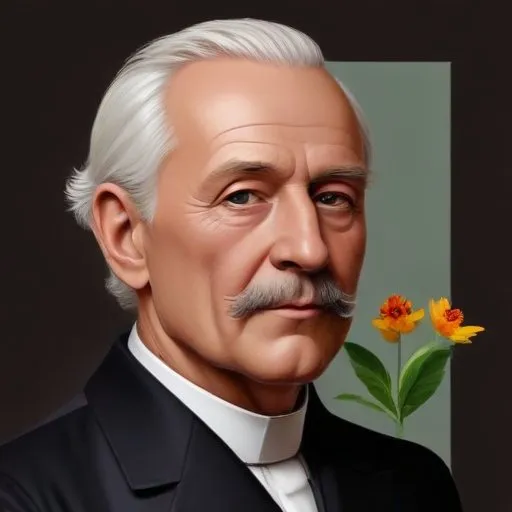
A German botanist who, along with Theodor Schwann, formulated the cell theory, which states that all living organisms are composed of cells and that cells are the basic units of life.
Matthias Jakob Schleiden is renowned for co-founding the cell theory, a fundamental principle in biology that states that all living organisms are composed of cells. Alongside Theodor Schwann and Rudolf Virchow, Schleiden's groundbreaking work in the 19th century paved the way for a deeper understanding of life and its intricate structures.
Schleiden was born on April 5, 1804, in Hamburg, Germany, to a family of modest means. His father, the municipal physician of Hamburg, encouraged his son's intellectual pursuits. However, Schleiden's early life was marked by emotional turmoil, including a period of depression and an attempted suicide, which left a prominent scar on his forehead. This dark episode led him to abandon his legal studies and seek a new path in life.
In 1835, Schleiden transferred to the University of Berlin, where he began studying natural science. It was here that he discovered his true calling – botany. Under the guidance of his uncle, Johann Horkel, Schleiden delved into plant embryology, becoming fascinated by the intricate structures and patterns found in plant life.
In 1838, Schleiden published his seminal work, Contributions to our Knowledge of Phytogenesis, in which he proposed that all plants are composed of cells. This revolutionary idea, developed in conjunction with Schwann, posited that cells are the fundamental building blocks of life. Furthermore, Schleiden recognized the significance of the cell nucleus, discovered by Robert Brown in 1831, and its role in cell division.
Schleiden's work, along with that of Schwann and Virchow, laid the foundation for modern biology. The cell theory, as it came to be known, provided a fundamental understanding of life, equivalent in importance to the atomic theory of chemistry. This concept has had far-reaching implications, influencing fields such as medicine, agriculture, and biotechnology.
In 1863, Schleiden became a professor of botany at the University of Dorpat, where he continued to study and teach botany. He spent the remainder of his life dedicated to his craft, leaving behind a legacy of groundbreaking research and inspired students.
Schleiden's contributions to cell theory have had a profound impact on our understanding of life and its many mysteries. His work has enabled scientists to better comprehend the intricacies of biological systems, leading to breakthroughs in fields such as medicine, agriculture, and biotechnology. Today, his legacy continues to inspire new generations of scientists and researchers.
"The cell is the ultimate unit of life, the basic building block of all living organisms."
Schleiden's words serve as a testament to his pioneering spirit and his enduring impact on the scientific community.
Born in 1810
Discovered the Schwann cells, a type of cell that provides support to neurons in the peripheral nervous system, and formulated the theory of cellular structure, which states that all living organisms are composed of cells.
Born in 1821
A pioneer in modern medicine, he founded the field of social medicine, emphasizing the importance of social and environmental factors on health, and made significant contributions to cellular pathology.
Born in 1800
German chemist and academic who synthesized urea, debunking the theory of vitalism, and made significant contributions to organic chemistry. He is considered one of the founders of modern organic chemistry.
Born in 1803
Developed groundbreaking theories on organic chemistry and agriculture, revolutionizing farming practices and earning the title "Father of Fertilizers".
Born in 1821
A 19th-century physician and physicist who made significant contributions to the fields of electromagnetism, thermodynamics, and the physiology of human perception, particularly in the study of vision and hearing.
Born in 1835
German chemist and Nobel laureate who synthesized barbituric acid and developed the theory of organic dyes, revolutionizing the textile industry. His work laid the foundation for modern dye chemistry.
