


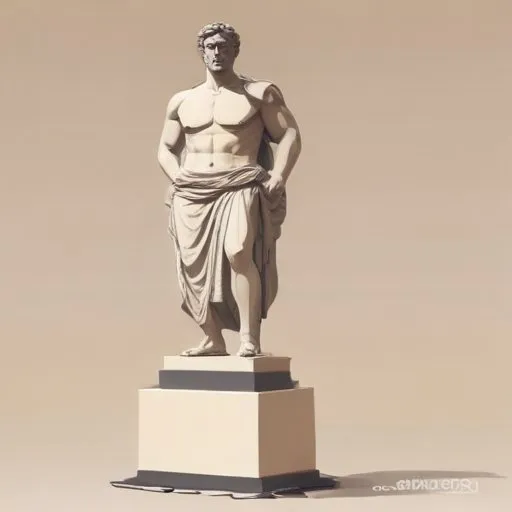
A pioneering Greek sculptor, known for blending traditional techniques with modernist styles, creating iconic public art installations that dot the Athenian landscape.
Memos Makris, a prominent Greek sculptor, is best known for his thought-provoking and iconic monuments that celebrate the human spirit, freedom, and the struggle against oppression. With a career spanning over five decades, Makris left an indelible mark on the world of art, politics, and culture.
Born on April 1, 1913, in Patras, Greece, Makris spent his early childhood in his hometown before moving to Athens in 1919. He pursued his passion for art at the Athens School of Fine Arts, where he honed his skills and soon became an integral part of the city's vibrant artistic and cultural scene in the 1930s.
During the German Occupation, Makris joined the National Resistance, fighting against the forces of oppression. After the liberation, he continued his studies in Paris, where he immersed himself in the city's thriving art scene. However, his political allegiance to the Left led to his deportation from France in 1950, and he sought political asylum in Hungary, where he became a prominent figure in the country's political and cultural life.
Makris' sculptures are a testament to his creative genius and commitment to social justice. Some of his most notable works include:
These works, among many others, adorn squares and buildings across Hungary, Greece, and Cyprus, serving as a reminder of the power of art to inspire and challenge society.
In 1964, Makris was deprived of his Greek nationality, but he regained it in 1975 after the restoration of democracy in Greece. In 1979, his first retrospective exhibition in Greece took place at the National Art Gallery, solidifying his position as one of Greece's most celebrated sculptors.
Memos Makris' life and work serve as a testament to the transformative power of art and the human spirit. Through his sculptures, he not only captured the essence of the human experience but also challenged the status quo, inspiring generations to come. His legacy continues to inspire artists, activists, and individuals around the world, cementing his place as one of the most important Greek sculptors of the 20th century.
Born in 1475
Renaissance master of iconic works like the ceiling of the Sistine Chapel, creating breathtakingly beautiful and emotionally powerful art that continues to inspire and awe.
Born in 1840
A French sculptor and illustrator famous for creating iconic, emotionally charged figures that capture the human experience, including the iconic symbol of intellectualism, The Thinker.
Born in 1898
A pioneer of modern sculpture, creating abstract, biomorphic forms that evoke a sense of primal emotion, and illustrating books with whimsical, dreamlike drawings.
Born in 1903
A pioneering modernist sculptor, creating abstract, biomorphic forms that explore the relationship between nature and the human experience. Her works often feature smooth, curved surfaces and holes, symbolizing a connection to the natural world.
Born in 1901
A pioneer of modern art, creating elongated, abstract human figures that capture the essence of humanity, and exploring the relationship between sculpture and space.
Born in 1904
A pioneering artist who blended Eastern and Western styles to create innovative sculptures and public spaces that harmonize nature and architecture. Known for iconic designs like the Noguchi coffee table and playgrounds that encourage creative play.
Born in 1893
A renowned Spanish artist, famous for his vibrant, dreamlike paintings and sculptures that blended abstraction and surrealism, creating a unique visual language. His works often featured bold colors, biomorphic forms, and a sense of playfulness.
