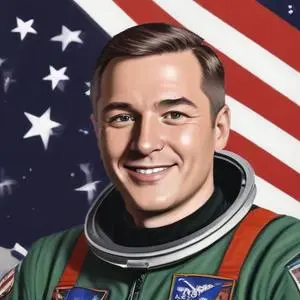
Michael P. Anderson: A Trailblazing Astronaut and American Hero
The Ill-Fated Columbia Mission
Michael P. Anderson was a United States Air Force officer and NASA astronaut who tragically lost his life in the Space Shuttle Columbia disaster on February 1, 2003. As the payload commander and lieutenant colonel in charge of science experiments on the Columbia, Anderson played a crucial role in the mission, making him an American hero and a pioneer in the field of space exploration.
Early Life and Education
Born on December 25, 1959, in Plattsburgh, New York, Anderson was the third child and only boy of Barbara and Bobbie Anderson. His father's career in the Air Force took the family to Fairchild Air Force Base in Washington, where Anderson spent most of his childhood. He graduated from Cheney High School in 1977 and went on to earn a Bachelor of Science degree in physics and astronomy from the University of Washington in 1981. Anderson furthered his education by completing a Master of Science degree in physics from Creighton University in 1990.
Air Force Career
Anderson's Air Force career began after graduating from the University of Washington, where he was commissioned as a second lieutenant. He completed technical training at Keesler Air Force Base in Mississippi and was assigned to Randolph Air Force Base in Texas. During his time in the Air Force, Anderson served as chief of communication maintenance for the 2015th Communication Squadron and later as director of information system maintenance for the 1920th Information System Group. In 1986, he attended Undergraduate Pilot Training at Vance Air Force Base, Oklahoma, and went on to become an EC-135 pilot, flying the Strategic Air Command's airborne command post, known as "Looking Glass."
NASA Career and the Columbia Disaster
Anderson was selected by NASA as an astronaut candidate in 1994. He flew on two Space Shuttle missions, STS-89 and STS-107, and logged over 593 hours in space. During the ill-fated STS-107 mission, Anderson was responsible for overseeing the scientific experiments on board the Columbia. On February 1, 2003, the Columbia disintegrated during reentry into the Earth's atmosphere, killing all seven crew members on board. The tragedy marked a somber moment in the history of space exploration, and Anderson's bravery and sacrifice will always be remembered.
Legacy and Honors
Posthumously, Anderson was awarded the Congressional Space Medal of Honor, the highest honor given to astronauts who have made the ultimate sacrifice in the pursuit of space exploration. Anderson's legacy extends beyond his heroic sacrifice; he paved the way for future generations of astronauts and scientists, inspiring countless individuals to pursue careers in STEM fields.
Quote and Memorable Saying
"The only thing that limits us is our own imagination." - Michael P. Anderson
Personal Milestones and Key Life Events
- Graduated from the University of Washington with a Bachelor of Science degree in physics and astronomy (1981)
- Received a Master of Science degree in physics from Creighton University (1990)
- Selected as a NASA astronaut candidate (1994)
- Flew on two Space Shuttle missions, STS-89 and STS-107 (1998 and 2003)
Historical Context and Legacy
Michael P. Anderson's contributions to space exploration and scientific discovery will forever be remembered. His bravery and sacrifice in the pursuit of advancing human knowledge have inspired countless individuals, and his legacy will continue to shape the future of space exploration.
FAQ
What was Michael P. Andersons role in NASA?
Michael P. Anderson was a NASA astronaut and a mission specialist on the Space Shuttle Columbias final mission, STS-107. He was responsible for conducting scientific experiments on board the shuttle.
What was Michael P. Andersons military career like?
Before joining NASA, Michael P. Anderson had a distinguished military career as a colonel in the US Air Force. He flew F-15 fighter jets and was a flight instructor at the US Air Force Academy.
What was Michael P. Andersons educational background?
Michael P. Anderson earned a Bachelor of Science degree in physics and astronomy from the University of Washington and a Master of Science degree in physics from Creighton University.
What awards did Michael P. Anderson receive?
Michael P. Anderson received several awards, including the Congressional Space Medal of Honor, the NASA Distinguished Service Medal, and the US Air Force Meritorious Service Medal.
What was Michael P. Andersons legacy?
Michael P. Andersons legacy is one of dedication to space exploration and scientific discovery. He was a role model for African Americans and minorities in STEM fields, and his contributions to the field of astronomy continue to inspire future generations.