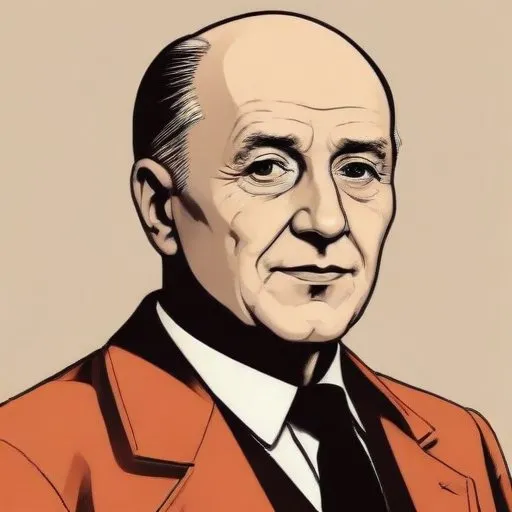
Otto Neurath

Otto Neurath

Otto Neurath was born on December 10th, 1882

Full Name: Otto Neurath
Place of Birth: Vienna, Austria-Hungary
Profession: Sociologist and Philosopher
Nationality: Austrian
Notable Work: International System of Typographic Picture Education
Influenced By: Marxism and Positivism
Birth Date: December 10, 1882
Death Date: December 22, 1945

Developed a visual approach to presenting complex social and economic data, creating a system of pictograms to convey information in a clear and concise manner.

Timeline
1882
Birth in Vienna, Austria-Hungary
Otto Neurath was born on December 10, 1882, in Vienna, Austria-Hungary, to a family of intellectuals. He would go on to become a renowned philosopher, sociologist, and economist.
1906
Earned Ph.D. in Philosophy
Neurath earned his Ph.D. in philosophy from the University of Vienna and began his academic career.
1919
Founded the Gesellschafts- und Wirtschaftsmuseum
Neurath founded the Gesellschafts- und Wirtschaftsmuseum (Social and Economic Museum) in Vienna, which aimed to promote public education and social reform.
1925
Developed the Vienna Method
Neurath developed the Vienna Method, a visual approach to statistics and communication that emphasized simplicity and clarity.
1945
Death in Oxford, UK
Otto Neurath passed away on December 22, 1945, at the age of 63, leaving behind a legacy as a pioneering philosopher, sociologist, and economist.
Otto Neurath

Otto Neurath Quiz

What was Otto Neurath's significant contribution to data presentation?

Score: 0/5
FAQ
What were Otto Neuraths contributions to sociology?
Otto Neurath was a key figure in the development of sociology as a discipline, and his work focused on the relationship between sociology and philosophy. He was a pioneer in the field of sociological theory and his work continues to influence sociologists today.
What is Otto Neuraths concept of social behaviorism?
Otto Neuraths concept of social behaviorism emphasizes the importance of understanding human behavior in social context. He argued that social behavior is shaped by a range of factors, including economic, political, and cultural forces.
What was Otto Neuraths role in the Vienna Circle?
Otto Neurath was a key member of the Vienna Circle, a group of philosophers and scientists who sought to develop a unified philosophy of science. He played an important role in shaping the Circles views on sociology and philosophy.
What are Otto Neuraths views on Marxism?
Otto Neurath was a critic of Marxism, and he argued that Marxist theory was too simplistic and failed to take account of the complexity of human behavior. He developed an alternative approach to social theory that emphasized the importance of empirical research and interdisciplinary collaboration.
What is Otto Neuraths legacy in modern sociology?
Otto Neuraths legacy in modern sociology is that of a pioneering thinker who sought to develop a more nuanced and comprehensive understanding of human behavior. His work continues to influence sociologists and philosophers today, and his emphasis on empirical research and interdisciplinary collaboration remains highly relevant.

Related People:

Ludwig Wittgenstein

Born in 1889

A philosopher who challenged traditional philosophy by emphasizing the importance of language and its limits, and is famous for his philosophical ideas on logic, reality, and the nature of meaning.

Moritz Schlick

Born in 1882

Developed the Vienna Circle's logical positivism, a philosophical movement that emphasized empirical evidence and rejected metaphysics. They also made significant contributions to the philosophy of science and ethics.

Rudolf Carnap

Born in 1891

Developed logical positivism, a philosophical movement that emphasized scientific evidence and rejected metaphysics, and made significant contributions to the fields of philosophy of language, philosophy of science, and epistemology.

Hans Hahn

Born in 1879

Austrian mathematician and philosopher who made significant contributions to topology, set theory, and philosophy of mathematics, and is known for his work on the Hahn-Banach theorem.

Philipp Frank

Born in 1884

A pioneer in logical positivism, he merged philosophy and science to understand the nature of reality, and his work significantly influenced the development of modern philosophy of science.

Victor Kraft

Born in 1880

A key figure in the Vienna Circle, this philosopher focused on the foundations of science, ethics, and the philosophy of language, making significant contributions to logical positivism.

Kurt Gödel

Born in 1906

A groundbreaking logician and philosopher who shook the foundations of mathematics with his incompleteness theorems, proving that no formal system can be both complete and consistent.