


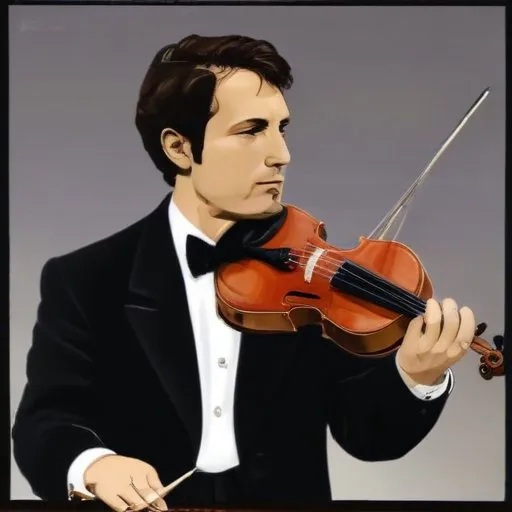
A renowned violinist and composer, known for his virtuosic performances and innovative compositions that blended traditional Polish folk music with modern classical styles.
Paul Kochanski, a Polish violinist, composer, and arranger, is renowned for his exceptional technique, profound interpretations, and innovative approaches to violin repertoire. Born in Odesa in 1887, Kochanski's remarkable career spanned across Europe and the United States, earning him acclaim as a soloist, chamber musician, and pedagogue.
Kochanski's early years were marked by an intense passion for music, which was nurtured by his father, a violinist himself. At the tender age of 7, Kochanski began studying with Emil Mynarski, a prominent Polish violinist and pedagogue. Mynarski's influence had a profound impact on Kochanski's development, and he eventually became the artistic guardian of the young prodigy.
In 1901, Kochanski was appointed concertmaster of the Warsaw Philharmonic Orchestra, a position he held until 1903. During this period, he began to make a name for himself as a virtuosic violinist, captivating audiences with his technical mastery and emotional depth. His talent soon caught the attention of Csar Thomson, a renowned Belgian violinist, who invited Kochanski to study at the Brussels Conservatoire.
It was in Brussels that Kochanski's artistic trajectory began to take shape. He formed a lifelong friendship with Arthur Rubinstein, a fellow Polish pianist, with whom he shared a deep musical affinity. Their collaborations, which began in 1907, resulted in some of the most iconic performances of the early 20th century, including interpretations of Beethoven's Kreutzer Sonata and Tchaikovsky's Piano Trio.
In 1916, Kochanski moved to the United States, where he established himself as a prominent figure in the American musical landscape. He continued to perform and teach, eventually becoming a professor at the Curtis Institute of Music in Philadelphia. His American sojourn also witnessed the development of his compositional skills, with works like the Violin Concerto in D major (1923) and the Sonata for Violin and Piano (1925) showcasing his melodic flair and harmonic richness.
Kochanski's influence on the world of classical music is multifaceted. As a performer, he introduced audiences to the richness of Polish music, promoting the works of compatriots like Karol Szymanowski and Mieczysław Karłowicz. As a pedagogue, he nurtured the talents of numerous students, including the renowned violinist, Ivan Galamian. Kochanski's legacy extends beyond the realm of music, symbolizing the bridge between Eastern European cultural heritage and Western artistic innovation.
Kochanski's remarkable life, marked by artistic innovation, cultural exchange, and a deep passion for music, continues to inspire generations of musicians and music lovers alike.
Born in 1887
A renowned pianist and educator, celebrated for his poetic and expressive performances of Chopin's music, as well as his charismatic stage presence.
Born in 1903
A renowned pianist and composer, celebrated for his virtuosic technique and powerful performances of classical music, particularly Chopin and Rachmaninoff.
Born in 1873
A renowned Russian musician who composed iconic symphonies and piano concertos, and was also a skilled pianist and conductor, leaving a lasting legacy in classical music.
Born in 1901
A virtuosic violinist renowned for his technical perfection, tone, and phrasing, revolutionizing the art of violin playing through his recordings and teaching.
Born in 1904
A virtuosic violinist and composer, renowned for his technical mastery and poetic interpretations of classical music, particularly Bach's solo violin works.
