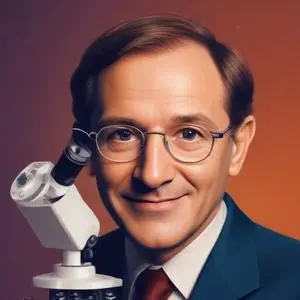
Paul L. Modrich: The Maverick Biochemist Behind DNA Mismatch Repair
A Pioneer in the Realm of DNA Repair
Paul L. Modrich is a name synonymous with groundbreaking research in DNA mismatch repair, a process that has far-reaching implications for our understanding of genetic mutations and their role in human disease. As a renowned American biochemist, Modrich has dedicated his career to unraveling the mysteries of DNA repair, earning him the esteemed Nobel Prize in Chemistry in 2015.
Early Life and Education
Born on June 13, 1946, in Raton, New Mexico, Modrich's fascination with the natural world was instilled in him from an early age. His father, Laurence Modrich, a biology teacher and coach, encouraged his curiosity, and his mother, Margaret McTurk, nurtured his inquisitive nature. Modrich's heritage is a rich tapestry of Croatian, Montenegrin, German, and Scottish Gaelic origins, with his paternal grandfather hailing from a small village near Zadar, Croatia.
Modrich's academic trajectory was marked by excellence, with a B.S. degree from the Massachusetts Institute of Technology in 1968 and a Ph.D. degree from Stanford University in 1973. His research journey continued with a postdoctoral fellowship in the lab of Charles C. Richardson at Harvard Medical School from 1973 to 1974.
Research and Breakthroughs
Modrich's research focus has been unwaveringly centered on DNA mismatch repair, a process that corrects errors that occur during DNA replication. His work has led to seminal discoveries that have reshaped our understanding of genetic mutations and their role in human disease. In 1976, Modrich joined the faculty at Duke University, where he has been a
Howard Hughes Investigator since 1995.
One of Modrich's most significant contributions has been the demonstration of how DNA mismatch repair serves as a "copyeditor" to prevent errors from DNA polymerase. His lab's biochemical experiments on E. coli led to the identification of proteins associated with mismatch repair in humans, a finding that has had far-reaching implications for our understanding of genetic mutations and their role in human disease.
Honors and Awards
Modrich's trailblazing research has been recognized with numerous honors and awards, including:
- Nobel Prize in Chemistry (2015)
- James B. Duke Professor of Biochemistry at Duke University
- Investigator at the Howard Hughes Medical Institute
Legacy and Impact
Paul L. Modrich's work has left an indelible mark on the field of biochemistry, paving the way for further research into the mysteries of DNA repair. His pioneering spirit and dedication to scientific inquiry have inspired generations of researchers, ensuring that his legacy will continue to shape the course of scientific discovery for years to come.
Personal Life
Modrich is married to fellow scientist Vickers Burdett, and their union has been a source of strength and inspiration throughout his career. His personal story is a testament to the power of curiosity, perseverance, and dedication to the pursuit of knowledge.
In conclusion, Paul L. Modrich's remarkable journey is a testament to the transformative power of scientific inquiry. His groundbreaking research has reshaped our understanding of DNA repair, earning him a place among the pantheon of great scientists. As we continue to unravel the mysteries of the human genome, Modrich's work will remain a beacon of inspiration, guiding us toward a brighter future for all humanity.
FAQ
What is Paul L. Modrichs contribution to the field of biochemistry?
Paul L. Modrich is a renowned American biochemist who made significant contributions to the understanding of DNA mismatch repair. His work led to a deeper understanding of the genetic mechanisms underlying cancer and other diseases.
What is Paul L. Modrichs Nobel Prize winning work?
Paul L. Modrich was awarded the Nobel Prize in Chemistry in 2015 for his mechanistic studies of DNA repair. His work, along with Tomas Lindahl and Aziz Sancar, provided insights into the repair of DNA lesions.
What is Paul L. Modrichs current role at Duke University?
Paul L. Modrich is the James B. Duke Professor of Biochemistry at Duke University, where he continues to conduct research on DNA repair and its implications for human disease.
How does Paul L. Modrichs work impact cancer research?
Paul L. Modrichs work on DNA mismatch repair has far-reaching implications for cancer research. His discoveries have led to a better understanding of the genetic mechanisms that drive cancer development and progression.
What is Paul L. Modrichs most notable scientific achievement?
Paul L. Modrichs most notable scientific achievement is the discovery of the molecular mechanisms underlying DNA mismatch repair, which has revolutionized our understanding of genetic stability and human disease.