


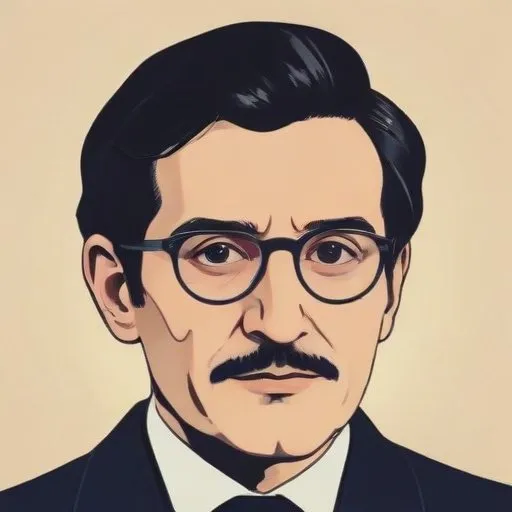
A pioneer in X-ray and gamma ray research, he developed the Langevin dynamics equation, a fundamental concept in statistical physics. His work laid the foundation for modern materials science and nanotechnology.
Paul Langevin, a renowned French physicist, is best known for developing the Langevin dynamics and the Langevin equation, which have had a profound impact on our understanding of physics. His work on paramagnetism and diamagnetism, as well as his pioneering efforts in the use of ultrasound for submarine detection, have cemented his place as one of the most influential physicists of the 20th century.
Langevin was born in Paris on January 23, 1872. He studied at the École de Physique et Chimie and the École Normale Supérieure, before moving to the University of Cambridge, where he worked under the guidance of Sir J. J. Thomson at the Cavendish Laboratory. In 1902, he obtained his PhD from Pierre Curie, with whom he would later develop a close professional and personal relationship.
Langevin's academic career was marked by significant contributions to the field of physics. In 1904, he became Professor of Physics at the Collège de France, and in 1926, he became the director of the École de Physique et Chimie, where he had been educated. He was elected to the Académie des sciences in 1934, a testament to his outstanding contributions to the field.
His work on paramagnetism and diamagnetism led to a deeper understanding of the phenomenon, and he is credited with developing the modern interpretation of this phenomenon in terms of electron spins within atoms. His collaboration with Constantin Chilowsky led to the development of two US patents in 1916 and 1917, relating to ultrasonic submarine detection.
Langevin's commitment to democracy and human rights led him to actively oppose fascism in the 1930s. He was a founding member of the Comité de vigilance des intellectuels antifascistes, an organization created to counter the rising tide of fascist ideology in Europe. His vocal opposition to fascism resulted in his arrest and house arrest by the Vichy government during World War II.
Despite these challenges, Langevin continued to fight for human rights and social justice. He served as the president of the Human Rights League (LDH) from 1944 to 1946, and was a member of the French Communist Party.
Langevin's personal life was marked by significant relationships with prominent figures, including Pierre Curie and his widow, Marie Curie. He is entombed at the Panthéon, a testament to his enduring legacy in French science and politics.
Langevin's contributions to physics, his commitment to democracy and human rights, and his defiance in the face of fascism have inspired generations of scientists and activists. His legacy serves as a powerful reminder of the importance of standing up against oppression and fighting for a more just and equitable society.
Born in 1867
A pioneering scientist who pioneered radioactivity research, discovering elements polonium and radium, and paving the way for breakthroughs in medicine and energy.
Born in 1859
A pioneer in radioactivity research, discovering elements like polonium and radium, and pioneering radioactive isolation techniques. Their groundbreaking work paved the way for advancements in medicine, energy, and materials science.
Born in 1879
A brilliant physicist who developed the theory of relativity and is considered one of the most influential scientists of the 20th century, known for his groundbreaking work in physics and mathematics.
Born in 1870
A Nobel Prize-winning physicist and chemist who pioneered the study of the atom, providing conclusive evidence for its existence and structure. Their work laid the foundation for modern particle physics.
Born in 1854
A pioneer in mathematics and physics, he laid the foundations for modern chaos theory, topology, and relativity, making groundbreaking contributions to our understanding of space and time.
Born in 1892
A French physicist and Nobel laureate who proposed that particles, such as electrons, can exhibit wave-like behavior, revolutionizing quantum mechanics. His hypothesis led to major breakthroughs in understanding the atomic structure.
Born in 1901
A pioneer in quantum mechanics, he formulated the uncertainty principle, which revolutionized our understanding of the atomic world. His groundbreaking work reshaped modern physics.
