


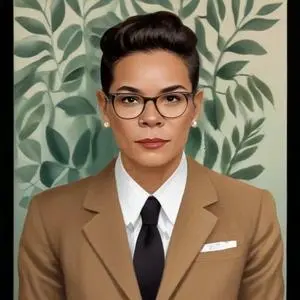
A pioneering figure in the fight for racial and gender equality, known for their groundbreaking work as a lawyer, priest, and author, leaving a lasting impact on the civil rights movement.
Pauli Murray, a trailblazing American civil rights activist, legal scholar, and Episcopal priest, is renowned for her groundbreaking work in expanding legal protection for gender equality and influencing the civil rights movement. Her tireless efforts to challenge racial and gender-based segregation earned her a reputation as a fierce advocate for social justice.
Born on November 20, 1910, in Baltimore, Maryland, Murray's early life was marked by hardship. After being orphaned, she was raised by her maternal aunt in Durham, North Carolina. Her determination and academic excellence led her to Hunter College in New York City, where she graduated with a Bachelor of Arts degree in English in 1933.
In 1940, Murray's bold act of civil disobedience – sitting in the whites-only section of a Virginia bus with a friend – resulted in her arrest. This experience, coupled with her involvement with the socialist Workers Defense League, solidified her resolve to pursue a career as a civil rights lawyer. She enrolled in Howard University's law school, where she was the only woman in her class, and graduated first in 1944.
Despite her academic achievements, Murray was denied the opportunity to pursue postgraduate work at Harvard University due to her gender. This experience led her to coin the term "Jane Crow," referring to the sexism and discrimination faced by women, analogous to the racial segregation enforced by Jim Crow laws. She went on to earn a master's degree in law from the University of California, Berkeley, and became the first African American to receive a Doctor of Juridical Science degree from Yale Law School in 1965.
Murray's legal career was marked by landmark achievements. Her 1950 book, States' Laws on Race and Color, was hailed as the "bible of the civil rights movement" by NAACP Chief Counsel Thurgood Marshall. She was appointed by President John F. Kennedy to serve on the Presidential Commission on the Status of Women from 1961 to 1963. In 1966, she co-founded the National Organization for Women (NOW), a leading feminist organization.
Ruth Bader Ginsburg, a renowned Supreme Court Justice, has credited Murray as a co-author of the ACLU brief in the landmark 1971 Supreme Court case, Reed v. Reed. Murray's work has inspired generations of activists, lawyers, and scholars, cementing her place as a pioneering figure in the struggle for civil rights and gender equality.
Murray received numerous awards and honors for her contributions to social justice, including the American Academy of Arts and Sciences' Award for Distinguished Service, the Martin Luther King Jr. Award, and the National Association of Black Journalists' Lifetime Achievement Award.
Pauli Murray's life and work continue to inspire social justice movements today. Her legacy serves as a testament to the power of determination, resilience, and advocacy in the pursuit of equality and human rights.
Murray's remarkable journey, marked by courage, conviction, and an unwavering commitment to justice, has left an indelible mark on American history. Her contributions to the civil rights movement and the struggle for gender equality have paved the way for future generations to build upon.
Born in 1913
Refused to give up her seat on a Montgomery, Alabama bus to a white person, sparking the Montgomery Bus Boycott, a pivotal event in the Civil Rights Movement.
97 Years Old
A prominent leader in the civil rights movement, advocating for racial equality and social justice through nonviolent means, leaving a lasting impact on American history.
Born in 1884
A humanitarian and politician who championed human rights, women's empowerment, and social justice, leaving a lasting impact on American politics and international relations.
Born in 1912
A pioneering figure in the struggle for racial and gender equality, she dedicated her life to empowering African American women and promoting education and social justice.
Born in 1924
A trailblazing African American congresswoman who broke racial and gender barriers, advocating for education, women's rights, and the poor. She was the first woman to run for the Democratic presidential nomination in 1972.
90 Years Old
A trailblazing lawyer and politician who broke racial and gender barriers, becoming the first African American woman elected to the Texas Senate and later a powerful voice in the US House of Representatives.
99 Years Old
African-American activist and author who played a crucial role in the Civil Rights Movement, advocating for racial and gender equality, and wrote extensively on her experiences and the movement.
96 Years Old
Co-founder of the United Farm Workers, a labor union that fought for the rights of farmworkers, improving their working conditions and wages. Known for her tireless advocacy and grassroots organizing.
