


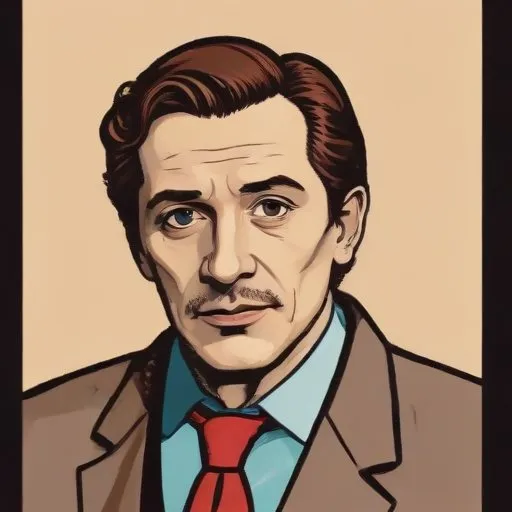
A Czech actor, director, and playwright known for his work in theater and film, particularly in the Czech New Wave movement, bringing avant-garde style to the screen.
Pavel Landovsk, affectionately known as "Lank," was a Czech actor, playwright, and director who became a beacon of resistance against the communist regime in former Czechoslovakia. His unwavering commitment to artistic freedom and human rights earned him a reputation as a prominent dissident, often at great personal cost.
Born on September 11, 1936, in Havlkv Brod, Landovsk's journey into the world of theatre began with multiple failed attempts to enter the Faculty of Theatre in Prague. Undeterred, he started his acting career as a supernumerary actor in regional theatres, eventually making his way to the inohern klub theatre in Prague.
In 1971, the communist regime banned Landovsk from film and television, but he continued to act at inohern klub and other theatres. His activism, particularly as one of the initiators of the human rights petition Charter 77, made him a thorn in the side of the authorities. As a result, he was constantly harassed by the secret police, Sttn bezpenost. In 1978-79, Landovsk was brutally beaten and had his leg broken by an agent. Fearing for his safety, he accepted a position in the ensemble of the Burgtheater in Vienna, Austria.
During his exile, Landovsk worked with renowned directors like Peter Zadek, but his heart remained in Prague. After the Velvet Revolution, he returned to his homeland in January 1990, resuming his acting career with performances at the Theatre on the Balustrade, National Theatre, Divadlo v Dlouh, and Divadlo Hybernia.
Landovsk's unwavering commitment to his craft and his principles is a testament to his unshakeable spirit. Despite facing persecution, imprisonment, and exile, he continued to create, inspire, and challenge the status quo. His legacy serves as a beacon of hope for those who dare to challenge oppressive regimes and fight for artistic freedom.
Pavel Landovsk's life and work serve as a powerful reminder of the importance of artistic freedom, human rights, and the unyielding spirit of dissent. His legacy continues to inspire generations of artists, activists, and free thinkers, ensuring that his voice will never be silenced.
90 Years Old
A Czech poet, playwright, and politician who led the country's transition from communism to democracy, and is known for his advocacy of human rights and individual freedom.
97 Years Old
A Czech-French writer who explored the human condition through novels, poetry, and plays, often blending philosophy and politics with a touch of irony and humor. His works are known for their lyrical style and exploration of themes such as identity, morality, and the search for meaning.
Born in 1914
A Czech writer celebrated for his poetic and humorous novels that explore the human condition, often set against the backdrop of World War II and communist Czechoslovakia.
Born in 1901
A Czech poet and journalist who captured the essence of his country's history and culture through his lyrical and expressive works, earning him the Nobel Prize in Literature.
Born in 1890
Czech author and playwright credited with coining the term "robot" and exploring the intersection of technology and humanity in his works, particularly in his play "R.U.R."
Born in 1883
A writer of surreal, psychologically complex fiction that explores the human condition, often featuring isolated protagonists in absurd, nightmarish scenarios.
