


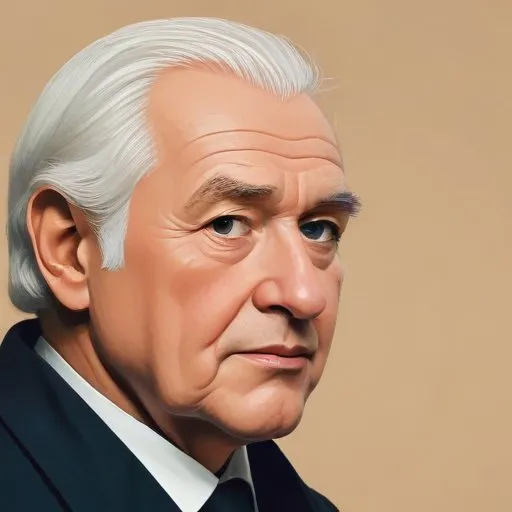
A Czech poet and journalist who captured the essence of his country's history and culture through his lyrical and expressive works, earning him the Nobel Prize in Literature.
Jaroslav Seifert, the renowned Czech writer, poet, and journalist, is celebrated for his profound literary contributions, which earned him the esteemed Nobel Prize in Literature in 1984. His poetry, characterized by freshness, sensuality, and rich inventiveness, has been praised for providing a liberating image of the indomitable spirit and versatility of humanity.
Born on September 23, 1901, in Žižkov, a suburb of Prague, Seifert's early life was marked by a passion for literature and art. His first collection of poems was published in 1921, setting the stage for a lifetime of creative expression.
In the 1920s, Seifert emerged as a leading figure of the Czechoslovak artistic avant-garde. He was a founding member of the influential journal Devtsil, which became a platform for modernist experimentation in art and literature.
Seifert's journalistic career spanned several decades, during which he worked for various communist newspapers and magazines, including Rovnost, Svetec, and Reflektor. He was also an active member of the Communist Party of Czechoslovakia, until he left in 1929, protesting against Stalinist tendencies in the party.
Seifert's literary prowess was recognized with several state prizes in 1936, 1955, and 1968. In 1967, he was designated National Artist, a testament to his significant contribution to Czech literature.
In 1984, Seifert was awarded the Nobel Prize in Literature, a crowning achievement in his literary career. Although he was not present at the award ceremony due to poor health, his daughter accepted the prize on his behalf.
Seifert's poetry and literary works have been instrumental in shaping the cultural identity of Czechoslovakia. His writing has inspired generations of writers, artists, and intellectuals, and continues to be celebrated for its powerful and liberating spirit.
Jaroslav Seifert passed away on January 10, 1986, at the age of 84. He was buried at the municipal cemetery in Kralupy nad Vltavou, where his maternal ancestors lay. His remarkable life and literary achievements continue to inspire and influence Czech culture to this day.
97 Years Old
A Czech-French writer who explored the human condition through novels, poetry, and plays, often blending philosophy and politics with a touch of irony and humor. His works are known for their lyrical style and exploration of themes such as identity, morality, and the search for meaning.
90 Years Old
A Czech poet, playwright, and politician who led the country's transition from communism to democracy, and is known for his advocacy of human rights and individual freedom.
Born in 1924
A Czech-Canadian author and publisher who wrote novels and essays that often blended elements of jazz, politics, and Czech culture, and founded a publishing house that promoted Czech literature worldwide.
Born in 1914
A Czech writer celebrated for his poetic and humorous novels that explore the human condition, often set against the backdrop of World War II and communist Czechoslovakia.
Born in 1926
A Czech journalist and author who wrote novels and essays that critiqued communism, and is best known for his 1967 novel "The Guinea Pigs" which satirized the Soviet occupation.
