


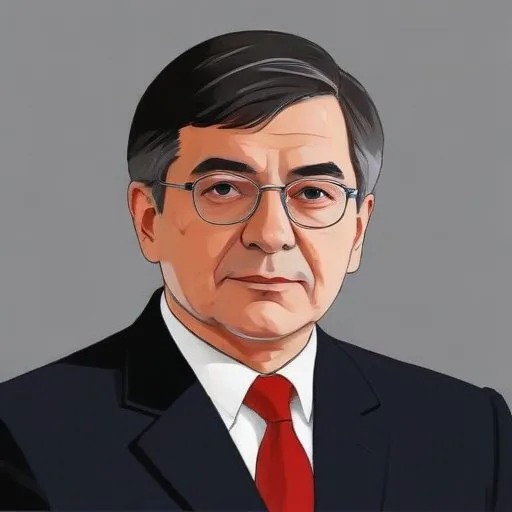
A German politician who served as a member of the Bundestag and held various ministerial positions, known for his work in foreign policy and European affairs.
Peter Hintze was a renowned German politician and a member of the Christian Democratic Union (CDU), who left an indelible mark on the country's political landscape. He is best known for his unwavering commitment to public service, serving as a member of the German Bundestag from 1990 until his untimely death in 2016.
Born on April 25, 1950, Hintze's entry into politics was marked by his election to the German Bundestag in 1990. During his tenure, he held various positions of significance, including the federal chairman of the Evangelical Working Group of the CDU/CSU from 1990 to 1992 and general secretary of the CDU from 1992 to 1998.
Hintze's contributions to German politics were recognized with his appointment as one of the six Vice Presidents of the Bundestag in 2013, a position he held until his passing in 2016. Additionally, he was Vice President of the Centrist Democrat International, a testament to his stature in global politics.
Hintze's career was marked by several notable milestones, including his role as Parliamentary State Secretary at the Federal Ministry of Family Affairs, Senior Citizens, Women and Youth under minister Angela Merkel in the fourth cabinet of Chancellor Helmut Kohl. He was also instrumental in the RoteSockenKampagne (Red Socks Campaign) in 1994, which contributed significantly to the CDU's electoral victory.
From 2005 to 2013, Hintze served as Parliamentary State Secretary at the Federal Ministry for Economic Affairs and Technology, working under various ministers, including Michael Glos, Karl-Theodor zu Guttenberg, Rainer Brüderle, and Philipp Rösler. During this period, he was also the government's Coordinator of Aerospace Policy.
Throughout his illustrious career, Hintze remained committed to his convictions, earning him the respect of his peers and the wider German public. His untimely passing on November 26, 2016, was met with an outpouring of tributes, celebrating his dedication to public service and his enduring impact on German politics.
Hintze's political ideology was deeply rooted in Christian Democratic values, which guided his policy decisions and informed his approach to governance. His commitment to social justice, economic development, and environmental sustainability reflected his profound understanding of the complex interplay between politics, society, and the environment.
In conclusion, Peter Hintze's remarkable career serves as a testament to his unwavering dedication to public service and his profound impact on German politics. His legacy continues to inspire future generations of politicians, policymakers, and citizens alike.
72 Years Old
The first female Chancellor of Germany, serving for 16 years, known for her leadership during the European sovereign-debt crisis and her role in shaping the European Union's policy. She's a highly influential figure in modern politics.
86 Years Old
A German pastor and politician who served as the 11th President of Germany, known for his advocacy of human rights and democracy, particularly during the country's reunification. He was a key figure in the peaceful revolution that brought down the Berlin Wall.
70 Years Old
The 14th Vice-Chancellor of Germany, a seasoned politician and academic, served as the country's second-highest ranking official, playing a crucial role in shaping Germany's domestic and foreign policies. He's known for his diplomatic efforts and commitment to European integration.
68 Years Old
A physician-turned-politician who served as Germany's Defense Minister and later became the President of the European Commission, known for shaping the EU's policies and response to global crises.
67 Years Old
A German educator and politician who served as the 17th Vice-Chancellor of Germany, known for his efforts in promoting social democracy and European integration. He played a key role in shaping Germany's foreign policy and economy.
