


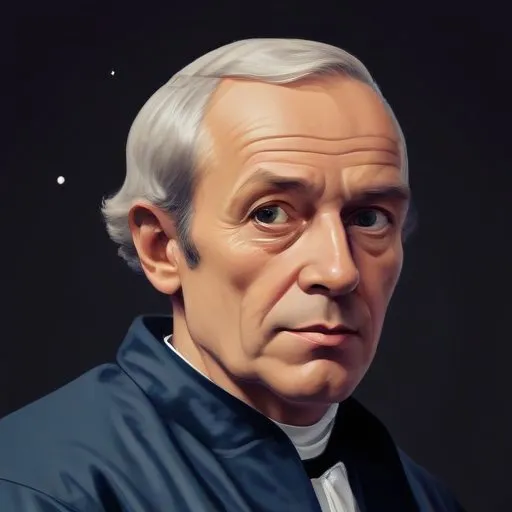
A 16th-century Dutch astronomer and mathematician who calculated the distance of the Sun and Moon from Earth, and developed new methods for astronomical calculations.
Philippe van Lansberge, a Flemish Calvinist minister, astronomer, and mathematician, is renowned for his groundbreaking work in creating a set of astronomical tables, Tabulae motuum coelestium perpetua, which enabled the prediction of planetary positions. This monumental achievement, published under his Latin name Philippus Lansbergius, has left an indelible mark on the field of astronomy.
Born on August 25, 1561, in Ghent, modern-day Belgium, Lansberge grew up in France and studied in England. After the Fall of Antwerp in 1585, he relocated to the northern part of the Netherlands, where he spent his life serving as a Protestant clergyman and pursuing his passion for astronomy.
Lansberge was an early proponent of the heliocentric theory, advocated by Copernicus, which posits that the Earth revolves around the Sun. This revolutionary idea, though controversial in both Catholic and Protestant circles, earned him recognition as a pioneering astronomer.
Lansberge's magnum opus, Tabulae motuum coelestium perpetua, was a comprehensive collection of astronomical tables that enabled the calculation of planetary positions. Although it contained some errors, primarily due to his rejection of Kepler's discovery of elliptical orbits, the work remains a testament to his dedication to astronomical research.
One of his notable students, Martinus Hortensius, collaborated with Lansberge on various projects, further solidifying his influence in the scientific community. His legacy extends to his sons, Pieter and Jacob, who followed in his footsteps, becoming a preacher and a medical doctor, respectively.
Lansberge's contributions to astronomy, though sometimes marred by errors, have had a lasting impact on our understanding of the celestial world. His unwavering dedication to his work, despite the controversies surrounding his ideas, serves as an inspiration to aspiring astronomers and scientists.
Though there are no recorded quotes from Lansberge, his work continues to speak volumes about his unrelenting passion for unraveling the mysteries of the universe.
Philippe van Lansberge's astronomical tables, though imperfect, have contributed significantly to the evolution of astronomy. His support for the heliocentric theory, despite the widespread opposition at the time, further underscores his commitment to advancing scientific knowledge.
As we gaze up at the starry skies, we are reminded of the tireless efforts of astronomers like Philippe van Lansberge, who have worked to unravel the secrets of the universe, leaving behind a legacy that continues to inspire and guide us.
Born in 1546
A 16th-century astronomer who made precise measurements of the stars and planets, laying the foundation for modern astronomy. His data helped Kepler discover planetary orbits.
Born in 1571
A 17th-century trailblazer who discovered the three laws of planetary motion, revolutionizing our understanding of the solar system. He's also credited with being a pioneer in the field of astrology.
Born in 1564
Pioneering astronomer, physicist, and mathematician who played a major role in the Scientific Revolution, making key discoveries that challenged Aristotelian views and laid the foundation for modern science.
Born in 1473
A Renaissance-era mathematician and astronomer who proposed the heliocentric model, where the Sun is at the center of our solar system, revolutionizing our understanding of the universe.
Born in 1629
A 17th-century polymath who made groundbreaking contributions to optics, probability theory, and astronomy, including the discovery of Saturn's rings and the largest moon, Titan.
Born in 1596
Developed influential philosophical and mathematical concepts, including the famous phrase "I think, therefore I am," and laid the foundation for modern Western philosophy.
Born in 1623
A 17th-century genius who made major contributions to mathematics, physics, and philosophy, inventing the mechanical calculator and developing the theory of probability. His writings also explored the human condition and faith.
