


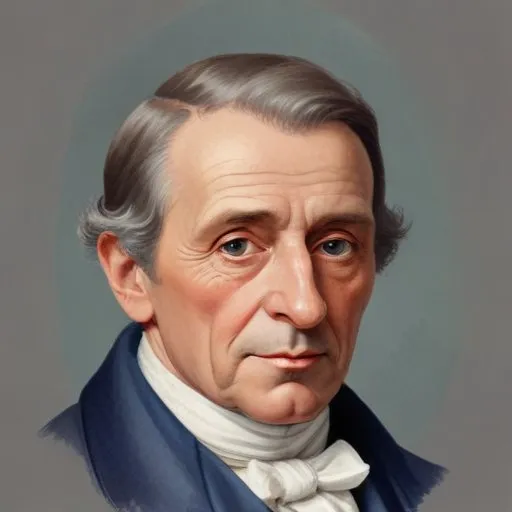
A French mathematician and academic who made significant contributions to differential geometry and was one of the founders of the modern theory of curves and surfaces. He is also known for his work on geodesics and the Gauss-Bonnet theorem.
Pierre Ossian Bonnet, a French mathematician born on December 22, 1819, in Montpellier, is renowned for his groundbreaking contributions to the field of differential geometry, particularly the development of the Gauss-Bonnet theorem. This fundamental concept has had a profound impact on our understanding of surfaces and their properties, influencing generations of mathematicians and physicists.
Bonnet's academic journey began at the Collège in Montpellier, where he laid the foundation for his future success. In 1838, he entered the prestigious École Polytechnique in Paris, followed by studies at the École Nationale des Ponts et Chaussées. These institutions provided him with a solid understanding of mathematics and engineering, which he would later apply to his research.
After graduating, Bonnet had a choice to make: pursue a lucrative career as an engineer or follow his passion for teaching and research in mathematics. Despite the financial uncertainty, he chose the latter, driven by his desire to make a meaningful impact on the field. In 1844, he secured a position at the École Polytechnique, where he began his work on differential geometry.
Bonnet's research on series led to a paper on the convergence of series with positive terms in 1843, which marked the beginning of his rise to prominence. In 1849, another paper on series earned him an award from the Brussels Academy. His work on differential geometry, particularly the Gauss-Bonnet theorem, cemented his reputation as a leading mathematician of his time.
Bonnet's contributions did not go unnoticed. He was elected to the Academy of Sciences in 1862, succeeding Biot, and later became a member of the Bureau des Longitudes in 1883, replacing Liouville. He also held positions at the École Normale Supérieure and the Sorbonne, solidifying his influence on the mathematical community.
Bonnet's work on differential geometry has had a lasting impact on mathematics and physics. His contributions to the concept of curvature and the development of the Gauss-Bonnet theorem have influenced numerous fields, from general relativity to computer graphics. His legacy continues to inspire mathematicians and scientists, ensuring his place in the annals of mathematical history.
Bonnet's personal life was marked by financial struggles, particularly in his early years. Despite these challenges, he remained committed to his research and teaching. He passed away on June 22, 1892, in Paris, leaving behind a rich legacy that continues to shape the mathematical community.
Through his tireless efforts and groundbreaking research, Pierre Ossian Bonnet has left an indelible mark on the world of mathematics, inspiring generations to come.
Born in 1789
Developed rigorous mathematical theories and introduced concepts like convergence and continuity, revolutionizing calculus and paving the way for modern mathematics.
Born in 1749
Developed nebular hypothesis of the origin of the solar system and formulated Laplace's equation, a fundamental concept in mathematics and physics. He's considered the founder of celestial mechanics.
Born in 1736
Developed calculus, number theory, and celestial mechanics, making significant contributions to the fields of mathematics and astronomy.
Born in 1752
Developed the theory of elliptic integrals, and his work on number theory laid the foundation for modern cryptography.
Born in 1777
A pioneer in mathematics and physics, he made major contributions to number theory, algebra, and electromagnetism, shaping our understanding of the natural world.
Born in 1802
A pioneer in mathematics, he made groundbreaking contributions to the field of algebra, particularly in the development of group theory and the proof of the impossibility of solving quintic equations using radicals.
Born in 1811
Developed the theory of groups, which revolutionized algebra and paved the way for modern number theory, and his work laid the foundation for many mathematical and scientific advancements.
Born in 1793
Developed a new branch of geometry, characterized by the use of imaginary points, lines, and planes, and made significant contributions to the field of projective geometry.
