


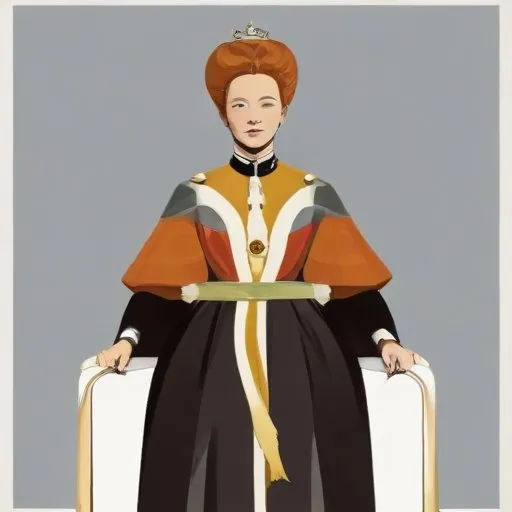
German princess who married into the Danish royal family and became the Duchess of Schleswig-Holstein-Sonderburg-Augustenburg, playing a key role in 19th-century European royal politics. She was a strong advocate for women's education and social welfare.
Princess Augusta of Hesse-Kassel, born Augusta Wilhelmina Louisa, is best known as the wife of Prince Adolphus, Duke of Cambridge, and the maternal grandmother of Mary of Teck, the wife of King George V of the United Kingdom. This remarkable woman led a life of nobility, duty, and philanthropy, leaving an enduring legacy in the British royal family.
Born on July 25, 1797, at Rumpenheim Castle in Offenbach am Main, Hesse, Princess Augusta was the third daughter of Prince Frederick of Hesse-Kassel and his wife, Princess Caroline of Nassau-Usingen. Through her father, she was a great-granddaughter of King George II of Great Britain, and her father's older brother was the Landgrave of Hesse-Kassel.
On May 7, 1818, Princess Augusta married her second cousin, Prince Adolphus, Duke of Cambridge, in a ceremony at Kassel, followed by a second ceremony on June 1, 1818, at Buckingham Palace. The couple had three children, and Augusta became the Duchess of Cambridge upon their marriage.
From 1818 until the accession of Queen Victoria in 1837, the Duchess of Cambridge lived in Hanover, where her husband served as viceroy on behalf of his brothers, King George IV and King William IV. During this period, Augusta demonstrated her philanthropic spirit by allowing a new village, founded in 1827, to be named after her - Augustendorf, which is now a component locality of Gnarrenburg.
As the longest-lived daughter-in-law of King George III, Princess Augusta played a significant role in the British royal family. Her son, Prince George, Duke of Cambridge, went on to become a prominent military figure, and her granddaughter, Mary of Teck, became the queen consort of King George V. Through her descendants, Augusta's legacy continues to shape the British monarchy.
Princess Augusta of Hesse-Kassel's life was a testament to her dedication to her family, her duties as a member of the royal family, and her commitment to philanthropy. Her legacy continues to inspire and influence the British monarchy to this day.
Born in 1819
The monarch who ruled the British Empire for 63 years, overseeing the Industrial Revolution and expanding the empire's reach, earning the nickname "the Grandmother of Europe".
Born in 1769
A French military leader who rose to prominence during the French Revolution and became Emperor of France, known for his military conquests and reorganization of Europe. He is also famous for his Napoleonic Code, which remains a foundation of modern law.
Born in 1755
The last queen of France before the French Revolution, known for her extravagance and mismanagement of the French economy, which contributed to the downfall of the monarchy.
Born in 1729
Empress of Russia from 1762 to 1796, she transformed her country into a major European power, modernizing its culture, politics, and economy through numerous reforms and conquests.
