


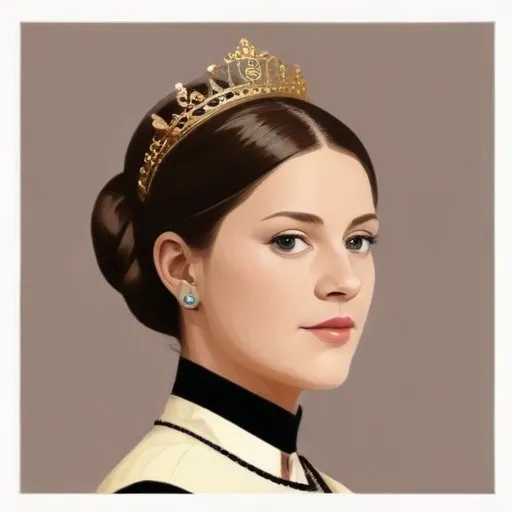
German princess and great-granddaughter of Queen Victoria, known for her marriage to Prince Alexander of Soloviev and her involvement in various charitable organizations.
As the Duchess of Saxe-Coburg and Gotha, Princess Victoria Adelaide of Schleswig-Holstein was a prominent figure in European royalty, known for her strong sense of duty and her ability to navigate the complexities of royal life. Through her marriage to Charles Edward, Duke of Saxe-Coburg and Gotha, she played a significant role in shaping the destiny of the German principality.
Born on December 31, 1885, at Castle Grünholz, Thumby, Schleswig-Holstein, Prussia, Princess Victoria Adelaide was the eldest daughter of Frederick Ferdinand, Duke of Schleswig-Holstein-Sonderburg-Glücksburg, and his wife, Princess Karoline Mathilde of Schleswig-Holstein-Sonderburg-Augustenburg. Her mother was a sister of Augusta Victoria of Schleswig-Holstein, who later became the German Empress through her marriage to Wilhelm II.
As a member of the House of Schleswig-Holstein-Sonderburg-Glücksburg, Princess Victoria Adelaide was raised with a strong sense of responsibility and duty. Her father, Frederick Ferdinand, had succeeded to the headship of the house and the title of duke upon the death of his father in 1885, just a month before her birth.
On October 11, 1905, Princess Victoria Adelaide married Charles Edward, Duke of Saxe-Coburg and Gotha, at Glücksburg Castle, Schleswig. The union was a strategic alliance between the two royal houses, strengthening the ties between Germany and the United Kingdom. As the Duchess of Saxe-Coburg and Gotha, Princess Victoria Adelaide played an important role in supporting her husband's duties as the ruling monarch.
As part of her royal duties, Princess Victoria Adelaide was involved in various charitable and cultural pursuits, reflecting her strong sense of compassion and her commitment to the welfare of her people. She was particularly interested in the education and empowerment of women, a cause that she actively supported throughout her life.
Princess Victoria Adelaide was known for her intelligence, kindness, and strong will. These qualities enabled her to navigate the complexities of royal life with grace and poise, earning her the respect and admiration of her contemporaries.
One notable aspect of Princess Victoria Adelaide's personality was her resourcefulness and practicality. According to a report in the Alcester Chronicle, a British local newspaper, she had gained a qualification from the Berlin Royal School of Cookery, demonstrating her willingness to acquire skills that would enable her to support herself, if needed.
Princess Victoria Adelaide's life was marked by her devotion to her family, her people, and her duties as a member of the royal family. Through her marriage and her role as the Duchess of Saxe-Coburg and Gotha, she played a significant role in shaping the destiny of the German principality, demonstrating her commitment to the welfare of her people and the preservation of royal traditions.
Today, Princess Victoria Adelaide of Schleswig-Holstein is remembered as a devoted wife, mother, and member of the royal family, whose life was characterized by her strong sense of duty, compassion, and kindness. Her legacy serves as a testament to the enduring power of royalty and the importance of devotion to one's people.
Through her life and legacy, Princess Victoria Adelaide of Schleswig-Holstein remains an important figure in European royal history, a testament to the enduring power of devotion, duty, and compassion.
Born in 1883
A member of the British royal family, she was a patron of the arts and supported charitable causes, particularly in the fields of education and healthcare.
Born in 1819
The monarch who ruled the British Empire for 63 years, overseeing the Industrial Revolution and expanding the empire's reach, earning the nickname "the Grandmother of Europe".
