


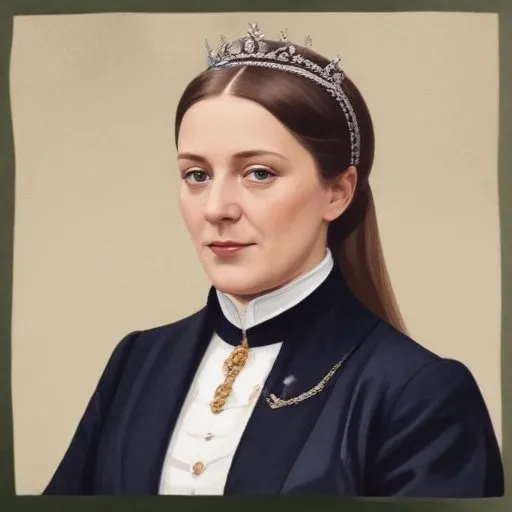
German Empress and Queen of Prussia, married to Wilhelm II, played a significant role in German politics and royal diplomacy during the late 19th and early 20th centuries.
Augusta Victoria of Schleswig-Holstein, also known as Dona, was the last German Empress and Queen of Prussia by marriage to Wilhelm II, German Emperor. She reigned from 1888 until the German Revolution in 1918, making her one of the longest-reigning empresses in German history.
Augusta Victoria was born on October 22, 1858, at Dolzig Castle, the eldest daughter of Frederick VIII, future Duke of Schleswig-Holstein-Sonderburg-Augustenburg, and Princess Adelheid of Hohenlohe-Langenburg. Through her mother, she was a niece of Queen Victoria, making her a member of the British royal family.
Augusta grew up at Dolzig Castle until the death of her grandfather, Christian August II, Duke of Schleswig-Holstein-Sonderburg-Augustenburg, in 1869. The family then moved to Castle Primkenau, where she spent the rest of her childhood. She was known within her family as Dona.
On February 27, 1881, Augusta married her half-second cousin, Prince Wilhelm of Prussia, becoming the Crown Princess of Prussia. The marriage was initially opposed by Wilhelm's family, as Augusta's father was not a sovereign. However, Chancellor Otto von Bismarck supported the union, believing it would end the dispute between the Prussian government and Augusta's father.
When Wilhelm became Emperor in 1888, Augusta became the Empress of Germany and Queen of Prussia. She played a significant role in supporting her husband during his reign, often serving as a mediator between Wilhelm and his government.
Augusta had a complex relationship with her mother-in-law, Victoria, who had hoped that Dona would help to heal the rift between herself and Wilhelm. However, Augusta struggled to fill the role of mediator, and the two women never fully reconciled.
Despite this, Augusta was deeply devoted to her husband and children, often prioritizing her family above her royal duties. She had seven children with Wilhelm, including five sons and two daughters.
Augusta's reign was marked by significant social and political changes in Germany. She was a strong supporter of the Red Cross and was involved in various charitable organizations throughout her life.
After World War I, Augusta's husband was forced to abdicate, and she went into exile with him in the Netherlands. She died on April 11, 1921, at the age of 62, and was buried in a simple ceremony in Doorn, Netherlands.
Born in 1819
The monarch who ruled the British Empire for 63 years, overseeing the Industrial Revolution and expanding the empire's reach, earning the nickname "the Grandmother of Europe".
Born in 1900
The wife of King George VI and mother of Queen Elizabeth II, known for her strong support of the British people during World War II and her iconic sense of style.
