


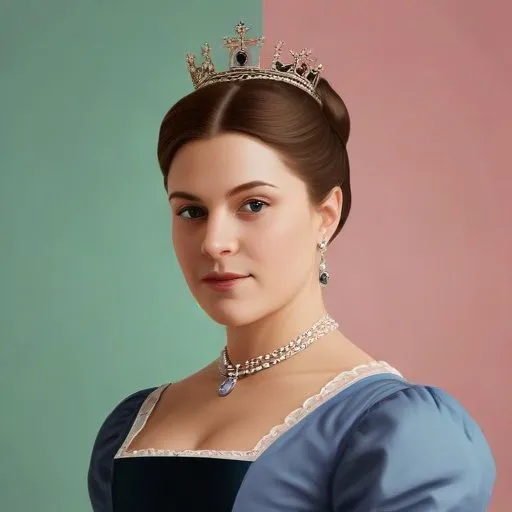
A German princess who married into the Russian royal family and was known for her beauty and scandalous marriages. She was a granddaughter of Queen Victoria and a cousin of King George V.
Princess Victoria Melita of SaxeCoburg and Gotha was a true original – a British princess born with a rebellious streak, known for defying convention and pushing boundaries throughout her extraordinary life. As the third child and second daughter of Alfred, Duke of SaxeCoburg and Gotha, and Grand Duchess Maria Alexandrovna of Russia, Victoria's unconventional choices sent shockwaves through the royal families of Europe.
Victoria's early life was marked by strict protocol and duty, but she soon developed a taste for freedom and independence. She fell deeply in love with her maternal first cousin, Grand Duke Kirill Vladimirovich of Russia, but their Orthodox Christian faith discouraged marriage between first cousins. Bowing to family pressure, Victoria married her paternal first cousin, Ernest Louis, Grand Duke of Hesse and by Rhine, in 1894.
However, the marriage was short-lived, and Victoria scandalized the royal families of Europe when she divorced her husband in 1901. This bold move was followed by an even more daring decision: marrying Kirill in 1905, without the formal approval of Britain's King Edward VII and Russia's Emperor Nicholas II. The couple's defiant union led to Kirill being stripped of his offices and honors, and they were initially banished from Russia.
Despite the backlash, Victoria and Kirill settled in Paris, had two daughters, and eventually relocated to Russia in 1910. However, their happiness was short-lived, as the Russian monarchy fell in 1917, and the couple was forced to flee to Finland. In exile, they lived among Victoria's relatives in Germany before eventually purchasing an estate in Saint-Briac, Brittany, where they spent their later years.
Victoria's unconventional life was a testament to her conviction that individuals should forge their own paths, free from the constraints of tradition and expectation. Her defiance in the face of royal protocol reflected her belief in personal freedom and autonomy. While she may not have left behind a written philosophical legacy, her life served as a powerful example of living authentically, even in the face of criticism and adversity.
Victoria's brave rejection of the status quo paved the way for future generations of women to challenge traditional roles and expectations. Her story inspires us to question authority, take risks, and live life on our own terms – a powerful message that resonates deeply in today's society.
Princess Victoria Melita of SaxeCoburg and Gotha's remarkable life serves as a testament to the power of individuality and the importance of living authentically. As we reflect on her extraordinary journey, we are reminded that true freedom lies in being true to oneself, no matter the cost.
Born in 1819
The monarch who ruled the British Empire for 63 years, overseeing the Industrial Revolution and expanding the empire's reach, earning the nickname "the Grandmother of Europe".
Born in 1885
The mother of Prince Philip, Duke of Edinburgh, was a Greek princess who married into the British royal family and overcame personal struggles, including deafness and mental health issues, to become a respected humanitarian. She's known for her bravery during World War II, hiding a Jewish family in her home in Athens.
