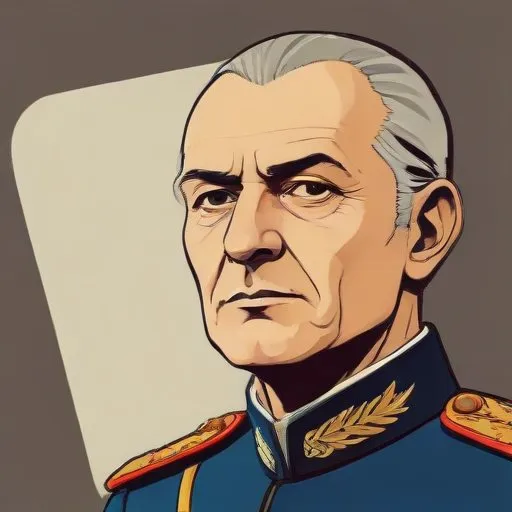
Radola Gajda: The Czech Military Commander and Politician Who Shaped the Course of History
A Fearless Leader in the Tumultuous Times of World War I and Beyond
Radola Gajda, born as Rudolf Geidl, was a Czech military commander and politician who made a significant impact on the world stage during the early 20th century. He is primarily known for his leadership roles in the Czechoslovak Legions, a Czech and Slovak military force that fought alongside the Allies during World War I, and his subsequent involvement in Czechoslovak politics.
Early Life and Military Service
Gajda was born on February 14, 1892, in Kotor, a coastal town in Montenegro, to an officer in the Austro-Hungarian Army and a poor Montenegrin noblewoman. He studied at a secondary grammar school in Kyjov, Moravia, before serving a year of compulsory military service in Mostar. Following this, he left for the Balkans, likely participating in the Balkan Wars of 1912-1913.
The Czechoslovak Legions and World War I
At the outbreak of World War I, Gajda rejoined the Austro-Hungarian Army, serving in Dalmatia and Sarajevo. However, in September 1915, he was taken prisoner in Viegrad, Bosnia. This pivotal event marked a turning point in his life, as he soon switched sides and was commissioned as a captain in the Montenegrin Army. Posing as a physician, he utilized his experience as an apothecary to aid his new comrades.
Rise to Prominence in the Czechoslovak Legions
After the collapse of the Montenegrin Army in 1916, Gajda escaped into Russia, where he joined a Serbian battalion as a physician. His next move would prove decisive: he joined the Czechoslovak Legions on January 30, 1917, as a staff captain. Gajda's leadership skills and bravery in the Battle of Zborov earned him rapid promotion through the military hierarchy.
Conflict with Masaryk and the Russian Civil War
During the evacuation of the Legion in May 1918 via the Trans-Siberian railway, Gajda commanded the area from Novonikolayevsk (Novosibirsk) north to Irkutsk. His aggressive tactics, sometimes against the orders of his superiors, contributed to the defeat of the Bolshevik forces and the connection of all Legion units. This, however, led to conflicts with Tom Garrigue Masaryk, who advocated for the Legions' neutrality in the Russian Civil War.
Legacy and Later Life
After the capture of Yekaterinburg by the Legion and the White Army in July 1918, Gajda established his headquarters in the city, setting up his office in the Ipatiev House. Although he later engaged in Czechoslovak politics, his legacy remains largely tied to his military achievements. Gajda passed away on April 15, 1948, leaving behind a complex yet fascinating historical footprint.
Historical Context and Legacy
Gajda's life and military career are inextricably linked to the tumultuous era of World War I and its aftermath. His participation in the Czechoslovak Legions and the Russian Civil War positioned him at the forefront of shaping the region's history. As a result, his legacy serves as a testament to the courage and determination of those who fought for their nations during this pivotal period.
Personal Milestones and Key Life Events
- Born on February 14, 1892, in Kotor, Montenegro
- Served in the Austro-Hungarian Army during World War I
- Joined the Czechoslovak Legions in 1917
- Participated in the Russian Civil War
- Established headquarters in Yekaterinburg in 1918
- Died on April 15, 1948
Trivia and Fun Facts
- Gajda's mother was a poor Montenegrin noblewoman.
- He pretended to be a physician due to his experience as an apothecary.
- Gajda's leadership skills earned him rapid promotion through the military hierarchy.
By examining the life and military career of Radola Gajda, we gain insight into the complexities and camaraderie that defined the Czechoslovak Legions and their role in shaping the course of World War I and its aftermath.
FAQ
What was Radola Gajdas role in the Czechoslovakian military?
Radola Gajda was a Czech commander and politician who served as the Chief of Staff of the Czechoslovakian Army from 1924 to 1926. He played a key role in modernizing the Czechoslovakian military and promoting its development.
What were some of Radola Gajdas notable military achievements?
Radola Gajda was a decorated military officer who fought in both World War I and World War II. He was awarded the Czechoslovak War Cross and the Order of the White Lion for his bravery and leadership.
How did Radola Gajda influence Czechoslovakian politics?
Radola Gajda was a prominent figure in Czechoslovakian politics, serving as a member of parliament and leading the National Fascist Community, a right-wing political party.
What was Radola Gajdas relationship like with other European leaders?
Radola Gajda was acquainted with several prominent European leaders, including Benito Mussolini and Adolf Hitler. He was known for his fascist and nationalist ideologies, which aligned with those of other right-wing leaders of the time.
What is Radola Gajdas legacy in Czechoslovakian history?
Radola Gajdas legacy is that of a complex figure who played a significant role in shaping Czechoslovakian military and politics. While his fascist and nationalist ideologies are controversial, he remains an important figure in Czechoslovakian history.