


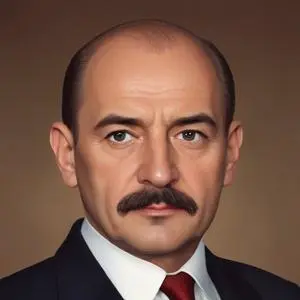
A Czech academic and politician who served as the 2nd and 4th President of Czechoslovakia, playing a key role in the country's independence and democratic development. He's known for his efforts to maintain Czechoslovakia's sovereignty during World War II and the Cold War.
Edvard Bene was a Czech politician and statesman who served as the president of Czechoslovakia from 1935 to 1938, and again from 1939 to 1948. Known for his skilled diplomacy and leadership during tumultuous times, Bene navigated his country through World War II and played a crucial role in shaping Czechoslovakia's future.
Bene was born on May 28, 1884, in the town of Kolany, Bohemia, which was then part of Austria-Hungary. He was the youngest son and tenth child of Matj Bene and Anna Petronila Bene. His family was of peasant origin, and his siblings included Vojta Bene, a future Czechoslovak politician.
Bene spent his youth in the Vinohrady district of Prague, where he attended grammar school from 1896 to 1904. He later studied at the Sorbonne, where he met his future wife, Anna Vlkov. The couple married in 1909 and had a lifelong partnership that supported Bene's political career.
Bene's political career began in 1918, when he became the first foreign affairs minister of Czechoslovakia. He served in this position until 1935, during which time he played a key role in shaping the country's foreign policy. In 1921, he became the fourth prime minister of Czechoslovakia, a position he held until 1922.
In 1935, Bene succeeded Tomas Masaryk as the president of Czechoslovakia. During his first term, he faced the Munich Agreement and the subsequent German occupation of Czechoslovakia in 1938. This led to his government's exile in the United Kingdom, where he continued to lead the Czechoslovak government-in-exile during World War II.
After the war, Bene returned to Czechoslovakia and resumed his presidency from 1939 to 1948. However, he faced another crisis in 1948, when the Communist Party seized power, and he was forced to resign once again.
Edvard Bene's legacy is marked by his tireless efforts to promote democracy and independence in Czechoslovakia. Despite facing numerous challenges and crises during his presidency, he remained committed to his country and its people. His diplomatic skills and leadership played a significant role in shaping the country's history during the tumultuous periods of World War II and the Cold War.
Bene's commitment to democracy and freedom also inspired future generations of Czech politicians and leaders. His legacy continues to be celebrated in Czechoslovakia, where he is remembered as a hero and a champion of democracy.
Bene's personal life was marked by his dedication to his family and his wife, Anna. The couple had no children of their own, but they were close to their nieces and nephews. Bene's nephew, Bohu Bene, was a diplomat and author, and his niece, Emilie Benes Brzezinski, was an American sculptor.
Bene's family was deeply rooted in Czech culture and politics. His brother, Vojta Bene, was a politician, and his nephew, Vclav E. Bene, was a Czech-American mathematician.
"The struggle for independence is not a matter of a day or a week, but a matter of generations."
"Democracy is not a gift, it is a conquest."
Edvard Bene's life and legacy serve as a testament to the power of democracy and independence. His commitment to his country and its people continues to inspire generations, and his impact on Czechoslovakia's history remains unparalleled.
Born in 1896
Leader of the Communist Party of Czechoslovakia who oversaw the country's transition to a socialist state and served as president from 1948 to 1953. He's known for his role in establishing a Soviet-backed government in Czechoslovakia.
89 Years Old
A Czech poet, playwright, and politician who led the country's transition from communism to democracy, and is known for his advocacy of human rights and individual freedom.
Born in 1886
Czech Minister of Foreign Affairs who played a key role in shaping the country's post-WWII foreign policy and was a strong advocate for democracy and human rights. He mysteriously fell to his death from a window in 1948, sparking conspiracy theories.
Born in 1880
A Slovak astronomer, general, and politician who made significant contributions to the development of astronomy in Slovakia and served as a general in the Czechoslovak Legion during World War I. He's also known for being one of the founders of Czechoslovakia.
