


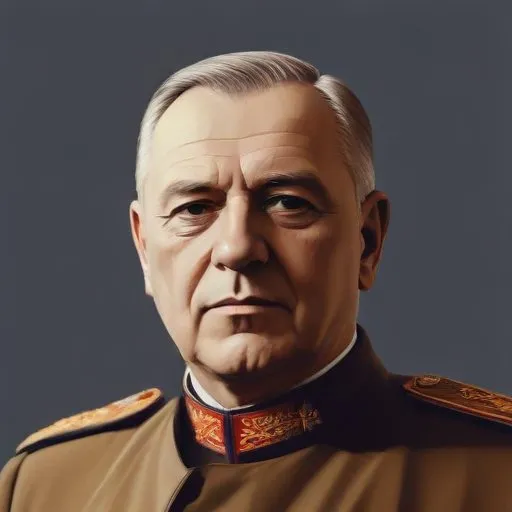
A Czech general and politician who served as the 8th President of Czechoslovakia, leading the country through a tumultuous period of Soviet occupation and reform. He's most known for his role in the Prague Spring and subsequent Soviet invasion.
Ludvík Svoboda was a Czech general and politician who is best known for his bravery during both World Wars and his subsequent presidency of Czechoslovakia from 1968 to 1975. Regarded as a national hero, Svoboda's life was a testament to his unwavering dedication to fighting for freedom and democracy.
Born on November 25, 1895, in Hroznatín, Moravia, Austria-Hungary, Svoboda's early life was marked by hardship. His father, Jan Svoboda, passed away when he was just one year old, leaving his mother, Františka, to raise him and his siblings on her own. After his mother remarried, Svoboda attended the agricultural school at Velké Meziříčí and worked at a vineyard.
In 1915, Svoboda was conscripted into the Austro-Hungarian Army, where he was sent to the Eastern Front. He was captured by the Russians and later joined the Czechoslovak Legion, participating in the battles of Zborov and Bakhmach. After returning home through Siberia, Svoboda began his military career in the Czechoslovak Army, rising through the ranks to become a lieutenant colonel by 1934.
When Nazi Germany occupied Czechoslovakia in 1939, Svoboda continued to fight against the occupation, becoming a key figure in the Czech resistance movement. He played a crucial role in organizing the resistance and was eventually forced to flee to the Soviet Union, where he formed the Czechoslovak military unit.
In 1968, Svoboda was elected President of Czechoslovakia, a position he held until 1975. During his presidency, he worked to democratize the country and improve relations with the West. After stepping down as president, Svoboda remained active in politics until his death on September 20, 1979.
Svoboda's legacy is one of heroism and selflessness. He played a crucial role in shaping Czechoslovakia's history, fighting for freedom and democracy throughout his life. Today, he is remembered as a national hero, and his bravery and dedication continue to inspire generations of Czechs.
Through his life and service, Ludvík Svoboda proved that even in the face of adversity, courage and determination can lead to a life of significance and lasting impact.
89 Years Old
A Czech poet, playwright, and politician who led the country's transition from communism to democracy, and is known for his advocacy of human rights and individual freedom.
Born in 1921
A Slovak politician who led a brief, failed attempt to reform communism in Czechoslovakia during the Prague Spring of 1968, known for his efforts to introduce democratic reforms.
Born in 1913
Led the Communist Party of Czechoslovakia, implementing reforms and normalizing relations with the Soviet Union after the Prague Spring. Known for his role in shaping the country's post-war history.
Born in 1922
A Czech communist politician who served as the General Secretary of the Communist Party of Czechoslovakia from 1953 to 1968, known for his role in suppressing democratic reforms.
Born in 1896
Leader of the Communist Party of Czechoslovakia who oversaw the country's transition to a socialist state and served as president from 1948 to 1953. He's known for his role in establishing a Soviet-backed government in Czechoslovakia.
Born in 1904
The President of Czechoslovak Socialist Republic and General Secretary of the Communist Party of Czechoslovakia, who ruled with an iron fist from 1957 to 1968, suppressing dissents and reform efforts. He's most known for his authoritarian regime and eventual ousting during the Prague Spring.
Born in 1884
A Czech academic and politician who served as the 2nd and 4th President of Czechoslovakia, playing a key role in the country's independence and democratic development. He's known for his efforts to maintain Czechoslovakia's sovereignty during World War II and the Cold War.
Born in 1886
Czech Minister of Foreign Affairs who played a key role in shaping the country's post-WWII foreign policy and was a strong advocate for democracy and human rights. He mysteriously fell to his death from a window in 1948, sparking conspiracy theories.
